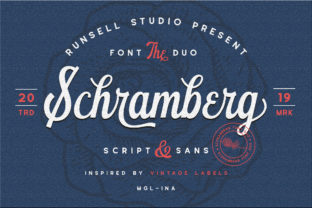
Brightside: A Vintage Script Font for Bold Design Statements
Brightside is a carefully crafted script font that draws on mid-century lettering traditions—think hand-painted signage, vintage packaging, and analog advertising from the 1940s–1960s. It features flowing, connected letterforms with subtle irregularities, modest contrast between thick and thin strokes, and gentle flourishes that evoke authenticity without overwhelming readability. Unlike highly ornate or decorative scripts, Brightside balances personality with restraint, making it suitable for applications where visual character matters—but legibility and tone remain priorities.
Designers and communicators often explore typefaces like Brightside when they need to reinforce brand warmth, heritage, or artisanal credibility. Its vintage aesthetic signals approachability, craftsmanship, and timelessness—qualities especially relevant for food brands, boutique services, lifestyle publications, and creative studios seeking distinction in saturated digital spaces. However, choosing Brightside isn’t just about liking how it looks; it’s about evaluating whether its formal qualities match functional needs across contexts.
When Brightside Supports Your Design Goals
Brightside excels in controlled, intentional applications. It works well as a display face—used sparingly for headlines, logos, packaging accents, or invitation typography—where its expressive rhythm can be appreciated at larger sizes (typically 36pt and up). Its connected lowercase forms and natural entry/exit strokes lend cohesion to short phrases, particularly those with rhythmic cadence (“The Wildflower Co.”, “Golden Hour Bakery”, “Haven & Co.”).
Because of its vintage grounding, Brightside pairs effectively with clean, neutral sans serifs (e.g., Inter, Lato, or Montserrat) or low-contrast serifs (e.g., PT Serif, Merriweather). This contrast helps ground expressive typography in clarity—ideal for websites or print collateral where hierarchy and scannability matter. In branding systems, Brightside often serves as a signature element: the “voice” behind a name, while supporting typefaces handle body text and interface labels.
Its stylistic consistency also makes it appropriate for projects emphasizing continuity across physical and digital touchpoints—such as café menus printed on kraft paper and mirrored on Instagram posts—where tonal alignment reinforces recognition.
Key Considerations Before Choosing Brightside
Like all script fonts, Brightside carries inherent tradeoffs. Its connected letterforms reduce flexibility in tight spaces or narrow columns. At small sizes (below 24pt), spacing and stroke detail begin to blur, diminishing legibility—especially on lower-resolution screens or in long-form reading environments. It is not designed for body copy, captions, data tables, or UI elements requiring rapid parsing.
Another practical consideration is language support. Brightside includes standard Latin characters (A–Z, a–z, numerals, basic punctuation), but does not extend to extended Latin diacritics, Cyrillic, Greek, or non-Latin scripts. Projects targeting multilingual audiences—or even English-language content with frequent accented terms (e.g., “café”, “naïve”, “résumé”)—may require supplemental fonts or manual glyph substitution.
Additionally, while Brightside’s irregularities contribute to its charm, they also mean tighter kerning control is needed during implementation. Some letter combinations (e.g., “st”, “ck”, “ft”) may require manual adjustment in design software to avoid unintended collisions or gaps—particularly when used at very large sizes or in motion graphics.
Situations Where Alternatives May Be More Suitable
If your project demands high legibility across variable conditions—such as mobile-first web interfaces, accessibility-compliant documents, or signage viewed from distance—Brightside’s stylistic emphasis may conflict with functional requirements. In those cases, more neutral script alternatives with higher x-heights, open counters, and consistent spacing (e.g., Playfair Display Italic, Cormorant Garamond Italic, or Quicksand) offer softer expressiveness with broader usability.
For designers needing a script that scales dynamically—from logo to app button—variable fonts with script axes (e.g., Bricolage Grotesque’s italic variants or Manrope with custom interpolation) provide more technical flexibility than static fonts like Brightside.
Similarly, if brand voice leans toward modern minimalism rather than nostalgic warmth, a geometric sans serif paired with a single elegant italic might achieve distinction more efficiently—without introducing the typographic complexity Brightside requires.
Practical Evaluation Steps
To determine whether Brightside aligns with your needs, begin by testing it against real content—not placeholder text. Set actual headlines, product names, or taglines in context: on a mockup of your website header, packaging die-line, or social media graphic. Observe how it behaves at intended sizes and on expected devices.
Next, assess contrast and hierarchy. Does Brightside create clear visual separation from supporting type? Does it compete with imagery or background textures—or enhance them? Print a sample at 100% scale and view it under typical lighting conditions to gauge perceived weight and texture.
Finally, consider implementation effort. If you’re working with developers, confirm whether Brightside is available via a reliable web font service (e.g., Google Fonts, Adobe Fonts, or self-hosted WOFF2) and whether fallback behavior has been planned. If licensing is required, verify usage scope—especially for commercial products, client work, or embedded applications.
Who Benefits Most From Brightside?
Brightside is most valuable to creators who prioritize tonal precision over typographic versatility. It suits independent designers building cohesive brand identities for small businesses rooted in craft, tradition, or locality. It also supports editorial designers developing visual themes for magazines, zines, or cultural campaigns where mood and historical resonance carry narrative weight.
It is less suited for enterprise-scale systems, government communications, educational materials requiring WCAG compliance, or fast-paced digital products where speed and clarity outweigh stylistic nuance.
In summary, Brightside is not a utility font—it’s a deliberate choice. Its value emerges when its vintage character directly supports communication goals, rather than merely decorating them. Evaluating it requires looking beyond aesthetics to ask: Does this typeface clarify meaning? Does it reflect values my audience recognizes and trusts? And does it perform reliably where it will actually be used?
Answering those questions honestly—not just liking how Brightside looks in a specimen image—leads to more sustainable, effective typographic decisions.