Baghotta: A Handwritten Font with Bold Swashes for Sophisticated Design
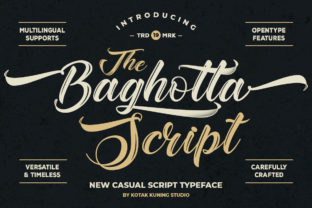
Baghotta is a distinctive handwritten typeface designed to bring elegance and intentionality to typographic layouts. Unlike many script fonts that prioritize speed or casual informality, Baghotta balances fluidity with structural confidence—its bold swashes are expressive but controlled, its letterforms organic yet consistent in weight and rhythm. It’s not merely decorative; it functions as a deliberate design element, best suited where personality and polish must coexist.
What Sets Baghotta Apart
At first glance, Baghotta stands out for its confident stroke modulation and generous swash extensions—particularly on uppercase letters like A, T, L, and Y. These aren’t ornamental afterthoughts; they’re integrated into the font’s underlying construction, ensuring alignment, spacing, and visual harmony across words and lines. The lowercase characters retain legibility even at smaller sizes, thanks to open counters and moderate contrast between thick and thin strokes.
Unlike calligraphic fonts built from broad-nib pen simulations—or those generated algorithmically to mimic brushwork—Baghotta feels hand-drawn by a practiced hand, with subtle irregularities that avoid mechanical repetition. Its baseline stability and even x-height also support readability in short-form applications, such as logos, invitations, or headline treatments where impact matters more than paragraph-length endurance.
Where Baghotta Fits Among Script Fonts
Script fonts fall broadly into three functional categories: formal scripts (like Snell Roundhand or Edwardian Script), casual handwriting styles (such as Pacifico or Dancing Script), and modern expressive scripts—a growing group that includes Baghotta. Within this last category, differentiation comes down to intent: some emphasize playfulness, others lean into minimalism or geometric restraint.
Baghotta occupies a middle ground. It’s less rigid than formal scripts, which often require careful kerning and tight line spacing to maintain dignity. It’s also more grounded than many casual options—those can blur into illegibility when scaled down or set in dense blocks. Compared to ultra-thin or high-contrast scripts, Baghotta’s robust weight distribution makes it more versatile for both digital interfaces and print materials where rendering fidelity varies.
Practical Strengths and Real-World Fit
Baghotta excels in contexts where tone and identity matter as much as information. Wedding stationery benefits from its graceful curves and confident presence—especially paired with clean sans-serif body text. Branding projects for lifestyle studios, artisanal goods, or boutique services use Baghotta effectively in logotypes or wordmarks, where it conveys craftsmanship without appearing dated or overly ornate.
Its bold swashes work well as standalone graphic elements: a single enlarged B or G can anchor a social media post or serve as a section divider in editorial layouts. Because the swashes are part of the font’s native glyph set—not added manually via vector shapes—they scale cleanly and retain proportionality across devices and resolutions.
In UI design, Baghotta is rarely appropriate for interface labels or navigation—but it performs reliably in hero banners, splash screens, or promotional modals where users pause briefly and absorb mood before engaging further. Its limited character set (standard Latin with basic punctuation and no extended diacritics) means it’s best reserved for English-language headlines or short phrases rather than multilingual or technical content.
Tradeoffs and Limitations to Consider
Like most expressive scripts, Baghotta isn’t built for extended reading. Its connected letterforms and variable spacing reduce scannability in paragraphs. Using it for body copy—even at larger sizes—introduces fatigue and slows comprehension. That’s not a flaw; it’s an intentional constraint aligned with its purpose.
Another consideration is licensing scope. Baghotta is typically distributed as a desktop font with web or app embedding requiring separate permissions. If your project involves dynamic text rendering—such as user-generated headlines in a web app or CMS-driven marketing pages—you’ll need to verify whether the license covers variable or runtime usage. Some alternatives offer broader licensing tiers, which may matter for agencies or SaaS platforms.
Also worth noting: Baghotta doesn’t include stylistic alternates or contextual ligatures beyond its core swash set. Designers who rely on OpenType features for fine-tuned control—like automatic swash substitution based on letter position—may find it less flexible than more feature-rich script fonts. That simplicity is part of its appeal for straightforward applications, but it limits granular customization in complex typographic systems.
When to Choose Baghotta—and When to Look Elsewhere
Baghotta is a strong choice if you need a script font that communicates sophistication without stiffness, and expressiveness without chaos. It works especially well when paired with neutral, highly legible typefaces—think Montserrat, Inter, or Lora—for contrast that highlights hierarchy without competing for attention.
Consider Baghotta for:
- Logo design for creative studios, wellness brands, or premium food and beverage labels
- Invitations, certificates, or packaging where tactile quality and visual distinction matter
- Digital campaigns targeting audiences who value authenticity and craft—particularly in lifestyle, fashion, or interior design sectors
- Printed collateral like lookbooks or annual reports where typography supports brand voice rather than conveys dense data
It’s less ideal when:
- You need multilingual support beyond basic Latin characters
- Your layout requires tight tracking or all-caps settings—Baghotta’s swashes lose impact without descending/ascending space
- You’re designing for accessibility-first environments where contrast, scalability, and screen reader compatibility are primary concerns
- The project demands rapid iteration across dozens of variants—Baghotta offers one weight and style, not a full family
Comparing Use Cases: A Practical Example
Imagine designing a logo for a ceramic studio named “Clay & Co.” You want warmth and individuality, but also timelessness. Baghotta’s C and l swashes suggest handmade care, while its upright stress avoids the slant-heavy feel of many cursive fonts—keeping the mark stable and memorable. In contrast, a looser, more irregular handwriting font might feel charming in isolation but lack cohesion across business cards, signage, and website headers.
Now imagine the same studio launching an e-commerce site with product descriptions, size charts, and customer reviews. Here, Baghotta would be reserved for the logo and perhaps section headings—while body text defaults to a tested, accessible sans-serif. That layered approach reflects how professionals use Baghotta: not as a universal solution, but as a considered accent within a broader typographic strategy.
Making an Informed Choice
Selecting a script font isn’t just about aesthetics—it’s about matching typographic behavior to communication goals. Baghotta delivers clarity of intent: it signals thoughtfulness, quality, and human touch without sacrificing visual authority. Its bold swashes aren’t arbitrary flourishes; they’re functional extensions of its structure, supporting emphasis and flow in ways that feel intentional rather than decorative.
If your priority is flexibility across weights, languages, or interactive contexts, other options may better serve long-term scalability. But if you’re seeking a focused, elegant, and cohesive handwritten voice—grounded in craft and calibrated for impact—Baghotta remains a compelling, well-executed option worth evaluating alongside alternatives.