Bookish: A Smart, Fun Display Font
When you’re choosing a font for a book cover, a workshop flyer, or even a boutique brand’s Instagram story, personality matters—not just polish. Bookish stands out because it doesn’t try to be everything. It’s a display font built for moments that need warmth, wit, and quiet confidence—like a well-chosen phrase on a handmade greeting card or the title of an independent podcast about storytelling.
What Makes Bookish Different—Without the Jargon
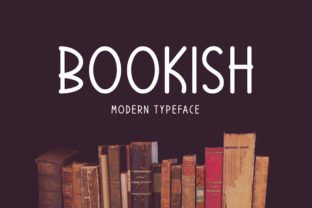
Bookish isn’t a system font. It’s not designed for body text or spreadsheets. It’s made for impact, but impact with intention. Its letterforms balance structural clarity with expressive quirks: slightly tapered terminals, subtle asymmetry in curves, and a rhythm that feels hand-informed—not hand-drawn. That distinction matters. It gives designers room to communicate tone without sacrificing legibility at medium sizes (think 36–96pt on screen or print).
Unlike many “playful” fonts that rely on exaggerated swashes or cartoonish proportions, Bookish keeps its intelligence visible. The lowercase a and g have considered shapes—not gimmicks. The uppercase M and W anchor compositions without shouting. That’s why it works equally well on a literary festival poster and a small-batch candle label: it supports the message instead of competing with it.
Where Bookish Fits Naturally—and Where It Doesn’t
Bookish shines in contexts where voice and visual cohesion matter more than neutrality. Think of it as the font you reach for when your goal is connection, not just clarity.
- Educators and course creators use Bookish for workshop titles and slide headers—it adds approachability to complex topics without diluting authority. A linguistics instructor might pair it with a clean sans-serif like Inter for body text, letting Bookish introduce each module with gentle emphasis.
- Independent publishers and zine makers appreciate how Bookish conveys craft and care. On a chapbook cover, it signals that the content inside values voice and detail—not mass production.
- Small business owners in creative fields—bakers, florists, ceramicists—find it bridges handmade charm and professional polish. Used sparingly on packaging or signage, it reinforces authenticity without veering into nostalgia overload.
- Bloggers and newsletter writers embed Bookish in featured headlines or section dividers. Because it’s optimized for web use (with variable weight options in some versions), it renders crisply across devices—no fuzzy edges, no layout shifts.
That said, Bookish isn’t ideal for long-form reading, data tables, or interfaces requiring rapid scanning. Its character set is robust but not exhaustive—some extended Latin characters or diacritics may be limited depending on the version. If your project demands multilingual support beyond English, French, Spanish, and German, verify glyph coverage before committing.
Practical Pairing—How to Use Bookish Without Overthinking It
Font pairing isn’t about rules—it’s about contrast with purpose. Bookish thrives alongside typefaces that offer structure, space, and restraint. Try it with:
- A neutral geometric sans-serif (e.g., Manrope or Public Sans) for balance—Bookish brings voice; the sans brings breath.
- A warm, low-contrast serif (e.g., Literata or PT Serif) for editorial depth—especially effective in magazine layouts or author websites.
- A monospaced font (e.g., IBM Plex Mono) for intentional dissonance—great in tech-adjacent creative studios wanting to signal both precision and humanity.
Avoid pairing Bookish with other high-personality display fonts. Two strong voices in one composition often cancel each other out. And while it’s tempting to use all five weights (if available), sticking to two—say, Regular and Bold—often yields cleaner results. Reserve the heaviest weight for primary headlines only; let the Regular carry subheads or short quotes.
Time-Saving Realities—Beyond Aesthetics
For freelancers juggling tight deadlines, Bookish can quietly reduce decision fatigue. When clients ask, “Make it feel warm but professional,” or “I want it to look thoughtful, not trendy,” Bookish delivers that nuance without needing custom illustration or extensive mockups. It’s a reliable starting point—not a final answer, but a strong first sentence in the visual conversation.
Designers also report faster client sign-offs when Bookish anchors early concepts. Its distinctiveness makes feedback more concrete (“I love the headline font—can we keep that?”) rather than vague (“Make it pop more”). That specificity saves rounds of revision—especially valuable when working remotely or under budget constraints.
A Note on Licensing and Flexibility
Bookish is typically offered under clear, straightforward licenses—most commonly for desktop, web, and app use with tiered pricing based on traffic or users. There’s no subscription model or usage-based metering, which simplifies planning for solopreneurs and small teams. Just confirm whether your intended use (e.g., embedding in a mobile app or reselling templates) falls within the license scope. Some foundries offer trial versions—test it in real layouts before purchasing, not just in specimen pages.
Who Benefits Most—and Why It’s Worth Considering Now
If you regularly design for audiences who value sincerity over slickness—readers, learners, local communities, niche hobbyists—Bookish aligns with how those groups respond to visual cues. It avoids the cold efficiency of corporate fonts and the dated whimsy of overused script fonts. Instead, it offers something rarer: intelligent friendliness.
That’s especially relevant today. As AI-generated visuals flood feeds and dashboards, human-crafted details—like the slight variation in Bookish’s ‘e’ bowls or the intentional spacing between ‘f’ and ‘l’—signal intentionality. Not perfection. Not automation. Just care.
It’s also future-resilient. Trends come and go, but fonts rooted in typographic craft tend to age well. Bookish won’t look “of 2024” in 2028—not because it’s bland, but because its personality comes from proportion and rhythm, not ornamentation.
Final Thought: Let Bookish Do the Talking—Then Step Back
The strongest use of Bookish isn’t when it dominates a layout, but when it frames something meaningful: a quote from a memoir, the name of a community garden, the tagline of a therapist’s website. In those moments, it doesn’t distract—it invites. It says, This matters. Let’s pay attention.
If your work lives at the intersection of idea and audience—if you’re choosing fonts not just to fill space but to deepen understanding—Bookish is worth adding to your toolkit. Not as a default, but as a deliberate choice. One that reminds both you and your viewers: clarity and charm don’t have to compete.