Radiant Script: When Vintage Elegance Meets Modern Design Needs
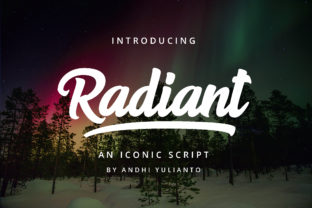
Radiant Script is a distinctive script font designed to evoke the warmth and craftsmanship of hand-lettered signage from the early-to-mid 20th century. Its flowing, slightly irregular strokes—paired with subtle variations in weight and rhythm—create an authentic vintage feel without sacrificing legibility or versatility. Unlike many decorative scripts that prioritize ornamentation over function, Radiant Script balances expressive character with practical usability across digital and print contexts.
What Sets Radiant Script Apart
At its core, Radiant Script is built around intentionality—not just aesthetics. Its letterforms feature gentle swashes, soft terminals, and organic spacing that mimics skilled penmanship rather than mechanical precision. The lowercase g, y, and Q carry graceful descenders; capitals include modest flourishes that enhance personality without overwhelming layout. These details contribute to a cohesive visual voice—one that feels personal, timeless, and quietly confident.
Unlike monoline scripts (which use uniform stroke widths) or ultra-bold display fonts (designed purely for impact), Radiant Script occupies a middle ground: it’s expressive enough for branding or invitations, yet restrained enough for short headlines, packaging copy, or editorial accents. Its design avoids extreme contrast or exaggerated connections between letters—making it more adaptable than many high-contrast scripts that struggle at smaller sizes or on low-resolution screens.
How Radiant Script Fits Within the Broader Script Landscape
Script fonts fall along a spectrum—from utilitarian handwriting styles to highly ornamental display faces. Radiant Script sits comfortably in the “refined vintage” segment: more structured than casual brush scripts like Homemade Apple or Brittany Signature, but less formal than copperplate-inspired typefaces such as Great Vibes or Allura. This positioning gives it flexibility where other scripts might falter.
For example, a wedding invitation suite may call for something delicate and romantic—where Radiant Script performs well alongside serif body text—but could also benefit from a bolder, more dramatic option if the couple prefers theatrical elegance. Similarly, a café menu seeking authenticity and charm may find Radiant Script ideal for section headers, while a luxury skincare brand might lean toward a more refined, tightly spaced script for premium perception.
Its moderate x-height and open counters support readability in medium-sized applications—say, a 24–36pt headline on a poster or banner. That’s not guaranteed with many vintage-style scripts, which often sacrifice clarity for stylistic flair. Radiant Script doesn’t require tight tracking or manual kerning adjustments in most standard uses, reducing production time compared to more finicky alternatives.
Practical Strengths and Real-World Fit
Radiant Script excels in contexts where tone matters as much as information. It conveys approachability, heritage, and care—qualities valuable in hospitality branding, artisanal product labels, boutique retail, editorial features, and event design. A small-batch bakery using Radiant Script for its logo and packaging signals tradition and attention to detail; a lifestyle blog applying it to article titles adds warmth without distracting from content.
It works especially well when paired with clean, neutral sans-serifs (like Inter, Open Sans, or Lato) or classic serifs (Merriweather, PT Serif). These pairings create visual hierarchy without competing voices—Radiant Script handles emphasis, while supporting typefaces manage structure and flow.
Because it’s typically offered in a single weight with optional alternate characters (such as swash capitals or contextual ligatures), Radiant Script encourages thoughtful typographic choices rather than relying on multiple weights or widths for variation. That simplicity can be an advantage for designers who value consistency and restraint—or a limitation for projects demanding bold/italic variants or extensive language support.
Tradeoffs and Situations Where Radiant Script May Fall Short
Like any specialized typeface, Radiant Script has boundaries. It is not intended for long-form reading: body text, captions, or interface labels will suffer from reduced scannability and increased cognitive load. Its rhythmic, connected forms don’t translate well to all-caps settings or tight line spacing—so avoid using it for navigation menus, data tables, or legal disclaimers.
It also assumes a certain level of typographic awareness. Without careful pairing and sizing, Radiant Script can unintentionally read as dated or overly nostalgic—especially in tech-forward or minimalist contexts. A fintech startup aiming for innovation and speed would likely find it mismatched, whereas a heritage watchmaker launching a limited-edition campaign might embrace its evocative qualities.
Language coverage is another consideration. While English, Western European, and some Central European characters are typically included, extended Latin, Cyrillic, Greek, or non-Latin scripts are rarely supported. Projects targeting multilingual audiences—or requiring accented characters beyond basic diacritics—should verify glyph availability before committing.
When to Choose Radiant Script—and When to Look Elsewhere
Radiant Script is strongest when your goal is to reinforce identity through tone and texture—not just communicate information. If you’re designing for an audience that values authenticity, craftsmanship, or emotional resonance, and your application stays within headline, logo, or accent use, Radiant Script offers reliable performance with minimal tuning.
Consider alternatives if:
- You need full typographic flexibility—including bold, italic, condensed, or variable axes;
- Your project requires extensive multilingual support or technical documentation;
- You're working under tight accessibility requirements where high contrast and clear letter distinction are mandatory;
- The visual context is highly modern, industrial, or conceptual—where vintage cues might dilute intent;
- You’re building reusable design systems where consistency across platforms and devices is non-negotiable.
In those cases, exploring humanist sans-serifs with script-inspired details (e.g., Quicksand or Cabin Sketch) or hybrid typefaces that blend script rhythm with geometric stability may yield better long-term results.
Making an Informed Choice
Selecting a script font isn’t about finding the “most beautiful” option—it’s about matching expressive capability to functional needs. Radiant Script stands out because it delivers vintage character without compromising usability in common design scenarios. It doesn’t try to be everything; instead, it does one thing well: lend warmth and distinction to moments that benefit from personality.
Before finalizing, test Radiant Script in your actual environment: render it at intended sizes on target devices, check contrast against background colors, and assess how it interacts with surrounding type. Compare it side-by-side with two or three alternatives—not just visually, but in terms of licensing scope, file size, and technical compatibility. Ask whether the impression it creates aligns with your audience’s expectations and your brand’s broader voice.
There’s no universal “best” script font. But for designers and brands seeking grounded elegance—where nostalgia serves purpose rather than cliché—Radiant Script remains a thoughtful, well-executed choice worth evaluating seriously.