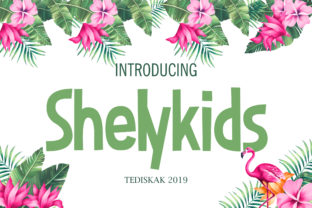
Shelykids: Where Playful Energy Meets Refined Typography
Typography isn’t just about legibility—it’s about voice, mood, and intention. When you’re designing a birthday invitation that makes kids giggle before they even open it, or crafting packaging for organic baby snacks that feels warm and trustworthy—not clinical—every curve and spacing choice matters. That’s where Shelykids steps in: not as a novelty font, but as a thoughtfully engineered sans serif with a bouncy, childlike soul and unmistakable elegance.
A Font That Bounces—Without Losing Its Balance
At first glance, Shelykids feels familiar—clean, airy, and uncluttered like many modern sans serifs. But look closer. The lowercase a has a soft, rounded bowl. The t tilts ever so slightly, like a toddler leaning into a hug. Ascenders on letters like h and l rise with gentle confidence—not rigid, not floppy, but *alive*. These aren’t arbitrary quirks. They’re intentional micro-adjustments that create rhythm and warmth without sacrificing clarity.
Unlike many “kiddie” fonts that lean heavily into cartoonish exaggeration—think wobbly outlines, exaggerated serifs, or forced cuteness—Shelykids keeps its structure grounded. Its x-height is generous (great for readability at small sizes), its letter spacing is open but purposeful, and its weight range includes Light, Regular, Medium, and Bold—each calibrated to retain that signature bounce across variations. You can set body copy in Regular and headlines in Bold without the design feeling disjointed. It breathes. It moves. It doesn’t shout.
Where Shelykids Fits in Real Creative Work
You won’t find Shelykids on every branding brief—and that’s by design. It shines brightest where authenticity and emotional resonance matter more than neutrality. Consider these everyday use cases:
- Educational apps for ages 3–8: Buttons, labels, and storybook headers gain instant approachability. Children recognize friendliness in shape and flow—even before they read words.
- Independent children’s book illustrations: Pair Shelykids with hand-drawn art, and the typography becomes part of the illustration—not a separate layer competing for attention.
- Parent-focused wellness brands: Think prenatal yoga studios, Montessori-inspired toy shops, or eco-conscious baby gear. Here, Shelykids conveys care and playfulness without infantilizing the adult audience.
- Print-on-demand greeting cards: A “Happy First Day of Preschool!” card gains sincerity when the type feels joyful but not silly—a subtle nod to milestone significance.
What sets Shelykids apart in these contexts is how well it scales emotionally. It doesn’t flatten complexity—it invites curiosity. A pediatrician’s office brochure using Shelykids for section headers and callouts feels reassuring, not patronizing. A museum’s early-learning program website uses it for activity titles, helping families instantly grasp tone before reading a single sentence.
Practical Considerations Before You Use It
Like any expressive typeface, Shelykids thrives with thoughtful application—not blanket deployment. Here’s what seasoned designers keep in mind:
- Pairing matters: Shelykids pairs beautifully with neutral, highly legible sans serifs like Inter, Lato, or even Helvetica Neue—but avoid other display or script fonts unless intentionally contrasting. Its personality is strong enough to carry weight; don’t crowd it.
- Size and context change perception: At 14px in UI text? Too playful for most interfaces. At 48px on a nursery wall print? Just right. Test it where it lives—not just in your font menu.
- Language support is expanding: The core family covers Latin-based languages thoroughly (including accented characters used in French, Spanish, and German). If you’re designing for multilingual children’s content, check current language coverage—but know that extended Cyrillic or Vietnamese support may require custom licensing or alternatives.
- Licensing is straightforward—but verify: Shelykids offers desktop, web, and app licenses. For SaaS platforms or white-labeled educational tools, confirm whether your plan includes embedding rights. Most independent creators and small studios find the standard license more than sufficient.
Why Designers Are Choosing Shelykids Over Generic Alternatives
It’s easy to reach for free rounded fonts when aiming for “friendly.” But generic options often lack nuance—either too stiff (like some over-engineered system fonts) or too chaotic (with inconsistent stroke contrast or uneven spacing). Shelykids was built with intentionality at every level:
- Optical sizing baked in: The Regular weight has slightly tighter spacing for headlines; the Light version opens up subtly for delicate captions—no manual tweaking needed.
- True italics—not slanted romans: Each italic glyph is redrawn with dynamic curves and relaxed terminals, preserving the bouncy rhythm instead of just tilting letters.
- Cross-platform consistency: Whether rendered on iOS Safari, Windows Chrome, or a printed brochure, Shelykids holds its character. Kerning pairs are tested across environments, so “VA” or “To” won’t collide or gap awkwardly.
This reliability saves time. One children’s publishing house reported cutting 30% off their typography QA cycle after switching from a mix of free fonts to Shelykids. No more hunting down rogue kerning issues in PDF exports or adjusting line heights per device.
Not Just for Kids’ Stuff—A Broader Emotional Palette
Here’s something unexpected: Shelykids works powerfully in projects that aren’t explicitly for children. A mental health startup targeting young adults uses it for quote graphics and workshop titles—its lightness signals openness, not immaturity. A sustainable fashion brand for teens chose Shelykids for campaign slogans because it feels human, unhurried, and quietly confident—unlike the aggressive sharpness of many trend-driven display fonts.
The key is recognizing that “childlike” doesn’t mean “childish.” It means curiosity. Spontaneity. Warmth without pretense. In an era saturated with slick, algorithm-optimized visuals, Shelykids offers a tactile, human counterpoint—one that connects faster because it feels *kind*.
Getting Started with Intention
If you’re evaluating Shelykids for an upcoming project, start small. Try it in three real contexts:
- A short headline paired with your existing body font
- A call-to-action button beside your current UI type
- A mockup of a physical item—like a sticker or tote bag label
Notice where it lifts energy and where it might distract. Does it feel cohesive with your color palette? Does it enhance—or compete with—your imagery? Trust your gut, but test objectively: show it to two people who match your target audience. Ask, “What emotion does this evoke?” before asking, “What does it say?”
When used with awareness, Shelykids doesn’t just decorate—it communicates before a single word is read. It says, We see you. We’re here to play, not perform. And in creative work that aims to inspire, comfort, or delight, that quiet assurance is everything.