Schramberg: Where Vintage Charm Meets Modern Design Confidence
Typography is rarely neutral—it carries tone, history, and intention. Among the growing library of expressive display fonts, Schramberg stands apart not by chasing trends, but by reinterpreting a timeless aesthetic with deliberate, contemporary strength. It’s not merely “vintage-inspired”; it’s a carefully calibrated balance of nostalgic warmth and bold structural clarity—designed to feel both familiar and freshly assertive.
The Handwritten Soul, Reinforced
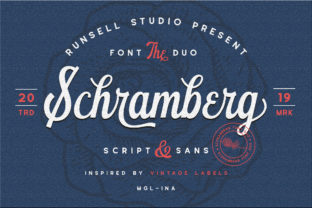
At first glance, Schramberg reads as handwritten: fluid entry strokes, subtle variation in line weight, and organic rhythm across letterforms. But look closer—the baseline remains remarkably steady, x-heights are generous and consistent, and key characters like B, R, and g carry intentional angularity and reinforced terminals. This isn’t accidental looseness; it’s controlled expressiveness. The “bold twist” isn’t just visual weight—it’s structural confidence built into every glyph.
Unlike many script fonts that sacrifice legibility for flourish, Schramberg maintains high readability at medium sizes (24–48px) without sacrificing character. Its spacing is open but purposeful, avoiding the cramped density that plagues overly decorative alternatives. That balance makes it unusually versatile: equally at home on a hand-painted café menu board and a responsive digital landing page headline.
Who Finds Schramberg Indispensable—and Why
Schramberg resonates across diverse professional contexts—not because it’s universally “safe,” but because its authenticity translates meaningfully in specific, human-centered scenarios.
- Craft-based businesses—bakeries, ceramic studios, small-batch distilleries—use Schramberg to signal care, tradition, and handmade integrity. A label reading “Small-Batch Maple Syrup • Since 1987” set in Schramberg feels earned, not curated.
- Educators and workshop facilitators lean into its approachability. A science outreach poster titled “How Bees Build Honeycomb” gains warmth and accessibility when rendered in Schramberg—inviting curiosity rather than intimidating with sterile sans-serif authority.
- Independent publishers and zine makers appreciate how Schramberg bridges editorial voice and tactile presence. In a literary magazine’s cover feature on rural oral histories, Schramberg’s texture echoes the grain of aged paper and the cadence of spoken storytelling—without resorting to clichéd “rustic” tropes.
- UX designers integrating brand voice occasionally deploy Schramberg selectively—not for body text, but for micro-interactions where personality matters: a “You’re all set!” confirmation message, or a playful “Try our new flavor” CTA button. Its boldness ensures visibility, while its handwriting roots soften functional language.
Real-World Observations: What Works—and What Doesn’t
In practice, Schramberg thrives when paired with restraint. A portfolio site for a textile conservator used Schramberg only for section headers (“Fibers • Dyes • Time”) over a neutral, highly legible serif body font. The contrast honored material history without overwhelming technical content. Conversely, a local theater’s season brochure overloaded Schramberg across headlines, subheads, *and* cast lists—resulting in visual fatigue and diminished hierarchy.
Its vintage resonance also depends heavily on context. On a sleek, minimalist tech startup’s homepage, Schramberg would clash unless intentionally juxtaposed for irony or narrative contrast (e.g., a headline like “We Built This the Old-Fashioned Way: With Real Code”). But in heritage-focused sectors—archival projects, historic preservation campaigns, or artisanal food branding—it often feels like the missing piece.
Technical Strengths That Enable Creative Flexibility
Beyond aesthetics, Schramberg’s utility stems from thoughtful technical execution:
- Robust OpenType features: Includes stylistic alternates for key letters (like a more upright or more slanted ‘a’), discretionary ligatures for natural flow (‘fi’, ‘fl’, ‘ct’), and contextual swashes that activate automatically in supported applications—adding nuance without manual intervention.
- Optimized hinting for screen use: Unlike many display fonts that pixelate below 36px on low-DPI screens, Schramberg renders cleanly down to 20px in modern browsers—critical for responsive navigation bars or mobile app headers.
- Comprehensive language support: Covers Latin Extended-A, including accented characters essential for French, Spanish, German, Polish, and Turkish—making it viable for international cultural projects, not just English-language design.
- Variable font axis (weight): Available in a variable version, allowing smooth transitions from medium to bold weight within CSS—ideal for interactive hover states or dynamic typographic scaling based on viewport width.
Implementation Nuances Worth Noting
Using Schramberg effectively requires attention to detail beyond font selection:
- Line length matters more than usual. Its rhythmic quality shines in shorter lines (30–50 characters). For longer paragraphs—even in large display sizes—line breaks should follow natural phrasing, not arbitrary character counts.
- Color contrast is non-negotiable. Its moderate stroke variation means light gray on white can vanish. WCAG AA compliance typically requires at least #333 on white, or white on deep charcoal (#222) for bold applications.
- Letter-spacing adjustments are situational. Default tracking works well for headlines up to ~40 characters. Beyond that, slight positive tracking (+10–20 units) improves word separation without breaking rhythm—especially important for all-caps usage.
- It resists over-styling. Drop shadows, heavy outlines, or extreme skew distort its core identity. Subtle text-shadow (1px black at 20% opacity) for depth on light backgrounds is often sufficient.
How Schramberg Fits Into Broader Design Trends—Without Following Them
Current design discourse emphasizes authenticity, craft, and anti-algorithmic expression—reactions against homogenized digital interfaces. Schramberg aligns with this shift, but not as a trend vehicle. Its value lies in its resistance to flattening: it doesn’t simplify human gesture into a UI component; it preserves the evidence of hand and intent.
Contrast it with the resurgence of “neo-grotesque” sans-serifs (like Inter or Manrope), prized for neutrality and scalability. Schramberg serves a different need: signaling *human authorship*. When a university’s climate research initiative uses Schramberg for its community engagement campaign (“What Does Your River Remember?”), it subtly communicates that data isn’t abstract—it’s tied to place, memory, and lived experience. That’s semantic weight no geometric sans-serif can replicate.
Similarly, it avoids the pitfalls of “retro” typography that relies on visual clichés—sunbursts, distressed textures, or exaggerated serifs. Schramberg’s vintage quality emerges from proportion and stroke modulation, not ornamentation. That subtlety allows it to age gracefully; a 2024 brand using Schramberg won’t look dated by 2030 simply because the font itself avoids temporal signifiers.
Practical Integration Across Tools and Workflows
Adopting Schramberg requires minimal workflow disruption:
- Web projects: Host via self-hosted WOFF2 files (smaller file size, broader browser support) or a reputable font service. Use
@font-facewithfont-display: swapto avoid invisible text during load. Pair with a system-ui or fallback serif for body copy. - Print and packaging: Embed fully in PDFs and Illustrator files. Its PostScript outlines render crisply at any scale—no pixelation risk on large-format signage or embossed business cards.
- Collaborative design systems: Document usage clearly—specify Schramberg as a “headline-only” typeface with explicit size ranges and pairing guidelines. Include examples of approved/unapproved combinations to prevent inconsistent application across teams.
- Accessibility-first considerations: Never use Schramberg for UI labels, form fields, or navigational links. Its decorative nature conflicts with WCAG 1.4.12 (Text Spacing) requirements for adjustable line height and letter spacing. Reserve it for purely presentational, non-interactive elements.
A Final Observation on Authenticity
Authenticity in design isn’t about replicating the past—it’s about honoring continuity. Schramberg doesn’t mimic 1940s signage or 1970s album art; it channels the underlying values those eras expressed through type: care in execution, respect for material constraints, and confidence in human gesture. That’s why educators use it to title lesson plans on oral history, why researchers choose it for exhibition titles about vernacular architecture, and why small business owners trust it to represent their decade-long commitment to a single craft.
Its boldness isn’t loudness—it’s assurance. Its handwriting isn’t informality—it’s invitation. And its vintage resonance isn’t nostalgia—it’s a quiet acknowledgment that some modes of human expression endure because they resonate deeply, not because they’re fashionable. In a landscape saturated with fleeting visual noise, Schramberg offers something rarer: typographic presence with staying power.