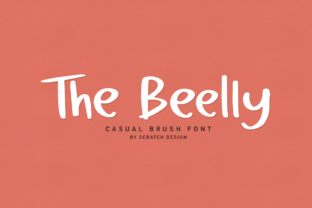
The Beelly: A Handwritten Font That Balances Personality and Practicality
Typography choices often carry more weight than they appear to—especially in branding, editorial design, and digital communication. Among the many handwritten fonts released in recent years, The Beelly stands out not for novelty or trend-chasing, but for its consistent execution and thoughtful restraint. It’s not flashy, nor does it try to mimic calligraphy or brushwork. Instead, The Beelly offers a grounded, chunky handwritten aesthetic that reads clearly at scale while retaining warmth and individuality.
A Font Built for Legibility and Presence
What defines The Beelly isn’t just its appearance—it’s how it functions across contexts. Its letterforms are intentionally generous: rounded terminals, open counters, and slightly widened proportions give it visual weight without sacrificing readability. Unlike many handwritten fonts that blur or collapse at smaller sizes, The Beelly holds up well from 16px body text (in select applications) to large-scale signage or cover art. The spacing is tuned—not overly tight, not artificially loose—so words flow naturally rather than feeling spaced-out or cramped.
This balance makes The Beelly especially effective where personality matters but clarity can’t be compromised: podcast episode titles, workshop handouts, newsletter headers, product packaging labels, or even slide decks for client presentations. It avoids the “overly casual” trap that can undermine credibility in professional settings—yet it never feels sterile or corporate.
Design Integrity and Consistency
One of the quiet strengths of The Beelly is its internal consistency. Each glyph maintains the same baseline rhythm, x-height proportion, and stroke contrast. There’s no jarring variation between uppercase and lowercase forms, nor do alternate characters disrupt the overall voice. While some handwritten fonts rely on randomized ligatures or swashes to simulate authenticity, The Beelly achieves character through deliberate, repeatable structure—not algorithmic unpredictability.
This reliability translates directly into workflow efficiency. Designers don’t need to spend time correcting uneven spacing, adjusting kerning pairs manually, or swapping glyphs mid-layout. Developers integrating it via web font services report few rendering inconsistencies across browsers or operating systems—particularly notable given how finicky some variable or script-based fonts can be on mobile Safari or older Android versions.
Where The Beelly Fits Best—And Where It Doesn’t
The Beelly excels in projects where tone and approachability matter, but authority and polish remain essential. Educators designing course syllabi or workshop materials find it works well for headings and section dividers—adding humanity without undermining professionalism. Small business owners use it effectively on café menus, local event posters, or handmade product tags, where a clean-but-personal voice helps distinguish them from generic templates.
Bloggers and content creators also benefit: The Beelly serves as a strong secondary typeface alongside a neutral sans-serif like Inter or Lato. Used sparingly—for pull quotes, chapter breaks, or featured headlines—it adds texture without competing with body copy. Its chunkiness ensures visibility in social media thumbnails or email subject lines rendered at small sizes.
That said, The Beelly isn’t ideal for dense long-form reading. Its lack of true italics (or stylistic alternates beyond standard weight variants) limits typographic hierarchy options in complex editorial layouts. It also doesn’t include extended language support beyond basic Latin—so multilingual publications requiring accented characters or non-Latin scripts will need complementary fonts. And while its weight range is usable, it doesn’t offer the full spectrum of a superfamily; users needing fine-grained control over light, medium, or black variants may need to pair it thoughtfully.
Real-World Use Cases and Observations
- Branding for service-based freelancers: A UX researcher used The Beelly for her portfolio site’s “Approach” section headers—pairing it with a crisp monospace for code snippets. Visitors consistently noted the site felt both human and precise, a reflection of her methodology.
- Educational printables: A literacy tutor created phonics flashcards using The Beelly for letter names and sounds. Teachers reported improved student engagement compared to standard sans-serif options—likely due to its friendly yet stable form.
- Local retail signage: A ceramic studio applied The Beelly to chalkboard-style window decals. Its chunky structure held up under natural light and distance better than thinner handwritten alternatives, maintaining legibility even when viewed from across the street.
Integration and Technical Considerations
Available in standard OTF and WOFF2 formats, The Beelly integrates smoothly into most design and development environments. It supports OpenType features like standard ligatures and contextual alternates—though these are subtle and purposeful, not decorative flourishes. For web use, its file size remains modest (~45 KB for WOFF2), helping maintain page speed without sacrificing quality.
When pairing The Beelly, avoid other highly textured or irregular fonts. It responds best to clean, structured companions: geometric sans-serifs (like Montserrat or Poppins), neutral humanist types (such as Nunito or Source Sans), or even restrained serifs like Merriweather for longer text blocks. Avoid pairing it with overly decorative script fonts—the contrast tends to feel forced rather than intentional.
Long-Term Value and Audience Alignment
For professionals who regularly produce visual assets—whether for clients, classrooms, or their own ventures—the value of The Beelly lies in its repeatability and adaptability. It doesn’t require constant reinterpretation or stylistic justification. You can use it today for a social media graphic, next month for a presentation deck, and six months later for a printed brochure—all without second-guessing whether it still “fits.”
This kind of dependable utility is rare among display fonts. Many handwritten options age quickly or feel tied to a moment in design trends. The Beelly, by contrast, avoids trend-dependent details like exaggerated ink bleeds, sharp angular joins, or excessive slant. Its design decisions prioritize function first—making it more likely to remain relevant across projects and platforms over time.
If your work involves balancing authenticity with polish—if you serve audiences that respond to warmth but expect competence—The Beelly earns its place in your toolkit. It won’t solve every typographic challenge, but it reliably solves several common ones: establishing voice without sacrificing clarity, adding distinction without demanding attention, and supporting intentionality without requiring heavy customization.
Ultimately, The Beelly is less about what it is and more about what it enables: confident, cohesive, and quietly distinctive communication—where the font supports the message instead of overshadowing it.