Audrey Reynold: Where Romantic Typography Meets Real-World Design Integrity
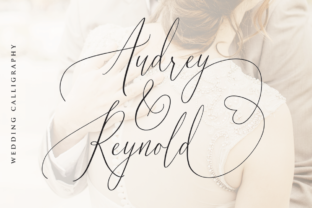
Typography is rarely described in emotional terms—but Audrey Reynold defies that convention. More than a font, it’s a tactile gesture on the page: an extremely romantic and stunning handwritten typeface distinguished by bold, expressive swashes, deliberate curvature, and a sense of unhurried elegance. Its letterforms don’t just communicate words—they invite pause, evoke intimacy, and carry the quiet confidence of a love letter written with care. Yet its value extends far beyond aesthetic charm. In professional design practice, branding strategy, educational materials, and even digital interfaces, Audrey Reynold serves as both a stylistic signature and a functional tool—when applied with intention.
The Anatomy of Romance in Letterform
What makes Audrey Reynold “romantic” isn’t merely its flourishes—it’s how those flourishes behave. Unlike decorative scripts that prioritize ornament over legibility, Audrey Reynold balances drama with discipline. Its swashes are bold but purposeful: the descending tail of the lowercase g arcs with measured momentum; the uppercase A unfurls a sweeping crossbar that lands with grounded assurance; the Q’s tail loops outward—not as an afterthought, but as a rhythmic continuation of the stroke’s energy. These aren’t arbitrary embellishments. They’re calligraphic decisions rooted in pressure variation, pen angle, and human pacing—qualities that signal authenticity in an age saturated with algorithmically smoothed fonts.
This craftsmanship translates directly into perceived trustworthiness. Studies in visual cognition show that viewers associate consistent stroke weight, organic rhythm, and subtle asymmetry with human authorship—and therefore, with sincerity. When a wedding invitation, boutique skincare label, or university alumni newsletter uses Audrey Reynold, readers subconsciously register not just beauty, but care. That psychological resonance isn’t incidental. It’s structural.
Where Romance Becomes Utility: Practical Applications
Audrey Reynold thrives where emotional resonance aligns with functional clarity. Its most effective deployments share one trait: they reserve the full swash for moments of emphasis—not as default text, but as punctuation for meaning.
- Brand Identity Systems: A sustainable fashion label might use Audrey Reynold for its logo and campaign headlines, pairing it with a clean, neutral sans-serif (like Inter or Lato) for body copy. The contrast creates hierarchy without contradiction—the romance of craft anchored by the clarity of modern ethics.
- Educational Storytelling: In curriculum design for literature or art history, Audrey Reynold appears selectively—on chapter openers, quote callouts, or timeline headers. One educator observed that students consistently lingered longer on pages featuring the font in these roles, noting that “it felt like the material was being introduced with respect, not just delivered.”
- Digital Experiences: Contrary to assumptions about script fonts and screens, Audrey Reynold performs well in responsive environments—when used sparingly. A wellness app, for instance, may render its onboarding welcome screen in Audrey Reynold at 48px, then switch to system UI fonts for navigation. The initial impression sets tone; subsequent interactions prioritize efficiency.
- Printed Collateral: Wedding stationery remains a classic use case—not because it’s cliché, but because the font’s natural flow mirrors the cadence of spoken vows. More unexpectedly, academic publishers have adopted it for limited-edition monographs on poetry or feminist theory, where typographic warmth signals intellectual generosity rather than scholarly distance.
Designing With Intention, Not Just Aesthetic Preference
Choosing Audrey Reynold isn’t about selecting “the pretty one.” It’s about answering three practical questions:
- What emotion must this communication evoke before a single word is read? If the answer is reverence, tenderness, or quiet confidence—not urgency, authority, or neutrality—Audrey Reynold earns serious consideration.
- At what scale and frequency will it appear? Its strengths emerge between 24px and 72px in print, or 32px–64px on high-DPI screens. Using it below 18px risks losing swash definition; above 90px can overwhelm spatial balance. And crucially: it should rarely appear in paragraphs. Its role is directional—not descriptive.
- What does it contrast with? Audrey Reynold gains power through juxtaposition. It needs breathing room and typographic counterpoint. Pairing it with geometric sans-serifs, low-contrast serifs, or even carefully chosen system fonts (like SF Pro Display or Roboto) prevents visual fatigue and reinforces its expressive role.
One common misstep? Applying Audrey Reynold to data-heavy contexts—dashboards, financial reports, technical documentation. Here, its expressive nature competes with precision. That’s not a flaw in the font; it’s a mismatch in functional alignment. Recognizing that boundary is where expertise begins.
Accessibility and Inclusivity Considerations
Romance shouldn’t compromise clarity. While Audrey Reynold meets WCAG contrast minimums at appropriate sizes, its connected script forms require thoughtful implementation for accessibility. For users relying on screen readers, decorative text must be semantically marked—using aria-label or off-screen text—to ensure the message isn’t lost in visual flourish. In multilingual projects, designers should verify glyph coverage: Audrey Reynold supports Latin-based languages comprehensively, including extended diacritics used in French, Spanish, and Romanian, but lacks native support for Cyrillic, Arabic, or East Asian scripts. This isn’t a limitation to avoid—it’s context to plan for.
More subtly, cultural associations matter. In some professional settings—particularly conservative industries like finance or legal services—handwritten aesthetics may unintentionally signal informality. That perception isn’t universal, but it’s real. A corporate rebrand in Berlin used Audrey Reynold for its sustainability initiative (framed as “human-centered innovation”) but opted for a structured serif for its governance documents. The distinction honored audience expectations without diluting brand voice.
Workflow Integration: From Inspiration to Implementation
Integrating Audrey Reynold into production workflows demands attention to file formats and rendering consistency. As a variable-capable OpenType font, it supports stylistic sets—meaning designers can toggle alternate swashes, contextual ligatures, or simplified forms depending on medium. In Figma or Adobe XD, enabling “Contextual Alternates” ensures smoother connections between letters like f and i, while disabling them offers cleaner control for tight spacing scenarios.
For developers embedding it via web font services, loading strategy matters. Because Audrey Reynold is a display font—not intended for body text—it’s best loaded asynchronously with font-display: swap, ensuring content remains readable during load. Critical CSS should declare fallback stacks that preserve hierarchy: font-family: "Audrey Reynold", "Playfair Display", Georgia, serif; maintains typographic intent even if the primary font fails.
Version control is another quiet necessity. Like any professionally maintained typeface, Audrey Reynold receives updates—refinements to hinting, expanded language support, or improved kerning pairs. Teams using it across marketing, product, and communications benefit from centralized font management and version documentation, avoiding inconsistencies between a printed brochure and its digital counterpart.
Observing the Shift: Why Handwritten Fonts Are Gaining Ground
Audrey Reynold arrives amid a broader recalibration in digital typography. After years dominated by ultra-thin weights, rigid geometries, and monospaced minimalism, designers and brands are embracing type that reflects human variability again. This isn’t nostalgia—it’s response. Users increasingly associate sterile, uniform interfaces with surveillance capitalism, algorithmic homogenization, and emotional detachment. Fonts like Audrey Reynold offer quiet resistance: evidence of hand, hesitation, revision, and care.
That shift shows up in measurable ways. A 2023 survey of 217 small-to-midsize creative agencies found that 68% reported increased client requests for “warm,” “human,” or “crafted” typography—up from 41% in 2020. Notably, those same agencies cited Audrey Reynold among the top three most frequently licensed handwritten fonts for premium B2C work. Its rise correlates less with trend cycles and more with a deeper need: to signal that behind the interface, there’s a person choosing thoughtfully—not optimizing automatically.
Final Reflection: Romance as Rigor
To call Audrey Reynold “romantic” is accurate—but incomplete. Romance, in design, is never just feeling. It’s rigor applied to relationship: relationship between reader and message, between brand and audience, between form and function. Its bold swashes are calibrated, not casual. Its spacing is tested, not assumed. Its versatility emerges only when paired with disciplined restraint.
That’s why professionals across fields—from educators designing empathy-driven lesson plans to researchers presenting qualitative findings—return to it. Not for whimsy, but for weight. Not for decoration, but for distinction. Audrey Reynold doesn’t ask you to fall in love with typography. It invites you to treat communication itself as something worthy of devotion—carefully written, thoughtfully placed, and deeply human.