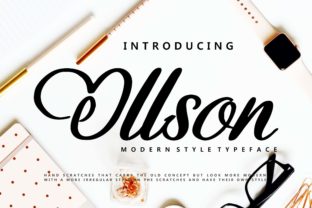
Ollson: A Bold, Natural Handwritten Font
There’s a quiet power in handwriting that digital type often struggles to replicate—immediacy, warmth, personality. Ollson isn’t just another script font; it’s a modern handwritten font with a bold touch, designed to carry the authenticity of human gesture while holding its own in professional contexts. If you’ve ever hesitated to use script fonts because they felt too fragile, too ornamental, or too hard to read at small sizes, Ollson bridges that gap. Its confident stroke weight, consistent rhythm, and subtle irregularities make it both legible and expressive—ideal for creators who need voice *and* clarity.
Why Ollson Fits Real Work—Not Just Mood Boards
Many handwritten fonts lean heavily into whimsy or nostalgia. Ollson avoids that trap. Its bold baseline gives it presence on screen and in print, while its natural charm comes from intentional imperfection—not wobbly inconsistency, but thoughtful variation in letterforms, spacing, and terminal flourishes. That balance means it works where softer scripts falter: on a product label viewed at arm’s length, in a presentation slide projected across a conference room, or as a logo lockup that scales cleanly from business card to billboard.
Consider a small-batch coffee roaster launching a new seasonal blend. They need packaging that feels artisanal but trustworthy—no sterile sans-serif, no overly decorative script that reads like a greeting card. Ollson delivers warmth without sacrificing authority. The boldness ensures the brand name stands out on a crowded shelf; the handwritten quality signals craft and care. It’s not “cute.” It’s considered.
Where Ollson Adds Quiet Efficiency
Time is rarely saved by fonts—but Ollson can reduce friction in visual decision-making. Because it’s highly legible at medium sizes and retains character at larger ones, you spend less time testing alternatives, adjusting tracking, or adding fallbacks. Designers report using fewer font families when Ollson anchors a project: one weight handles headlines, subheads, and short quotes, eliminating the need to pair multiple scripts or switch between light and bold variants.
For educators building digital lesson materials, this matters. A teacher creating printable worksheets or interactive slides doesn’t need to hunt for a “friendly but readable” font for instructions and titles. Ollson’s open counters and generous x-height mean students with emerging reading skills—or those viewing on lower-resolution devices—can parse text without strain. Its rhythm also supports scannability: key phrases stand out naturally, not because of color or size alone, but because the letterforms themselves guide the eye.
Who Benefits Most—and Why
- Freelancers and small studios: Clients often ask for “something hand-drawn but professional.” Ollson answers that brief without requiring custom illustration or complex vector work. It’s ready to drop in, adjust, and deliver—cutting revision rounds when tone and trust are equally important.
- Bloggers and content creators: In a feed saturated with uniform sans-serifs, Ollson adds distinctive visual texture to pull quotes, section headers, or callouts—without triggering accessibility warnings. Its contrast ratio meets WCAG AA standards at 18px and above, making it safer than many script fonts for body-adjacent uses.
- Small business owners: Think boutique fitness studios, independent bookshops, local ceramics studios. These brands rely on consistency across Instagram posts, email newsletters, and printed signage. Ollson scales reliably: it reads clearly in a tiny Instagram bio, holds weight in a large wall mural, and remains legible when laser-etched onto wood or metal.
A Note on Fit—Not Every Project Needs Bold Handwriting
Ollson shines where humanity and confidence coexist—but it’s not universal. For dense long-form text (think whitepapers or legal disclaimers), its personality becomes a distraction. Its strengths lie in brevity: headlines, logos, invitations, packaging copy, social highlights, and short-form web content. If your project demands neutrality, extreme scalability down to 10px, or tight typographic control in multi-column layouts, a robust serif or geometric sans may serve better.
Also worth noting: Ollson includes standard OpenType features—ligatures, stylistic alternates, and contextual swashes—but these are tastefully restrained. You won’t find dozens of alternate ‘a’ glyphs competing for attention. Instead, subtle variations appear only where they enhance flow (like the connected ‘f-l’ ligature) or reinforce emphasis (a slightly bolder ‘t’ in all-caps settings). This restraint makes it easier to use well, especially for non-designers.
Practical Tips for Getting the Most From Ollson
- Pair intentionally, not automatically. Avoid pairing Ollson with other scripts—it competes rather than complements. Instead, try it with a warm, low-contrast sans-serif (like Inter or Manrope) or a sturdy, slightly rounded serif (like IBM Plex Serif). The contrast should feel purposeful, not jarring.
- Respect its natural rhythm. Ollson’s spacing is calibrated for readability—not tight kerning. Avoid forcing aggressive letter-spacing or tracking adjustments unless you’re aiming for deliberate distortion (e.g., a distressed poster effect). Let the font breathe.
- Use weight strategically. While Ollson currently offers one primary weight, its boldness means hierarchy often comes from size, color, or placement—not weight shifts. A 36px headline and 18px subhead in the same weight create clear visual order without introducing visual noise.
- Test early in context. Preview Ollson on the actual devices and surfaces your audience will see it on—especially if printing on textured paper or displaying on OLED screens. Its ink-trap–inspired terminals help prevent filling-in on low-res output, but real-world testing still matters.
Ollson doesn’t shout. It leans in. That’s what makes it useful—not just beautiful. It’s the kind of typeface that helps a newsletter subject line feel personal instead of automated, makes a workshop flyer feel inviting instead of generic, and lets a founder’s quote land with sincerity instead of polish. In an era where audiences tune out anything that feels templated or transactional, Ollson offers a simple but meaningful alternative: typography that remembers it’s made for people.
If you’re choosing fonts to support goals—not just aesthetics—you’ll find Ollson earns its place not through novelty, but through reliability dressed in warmth. It’s handwriting with backbone. And sometimes, that’s exactly what your next project needs.