Santoy: A Light-Handed Yet Bold Handwritten Font That Delivers Visual Impact
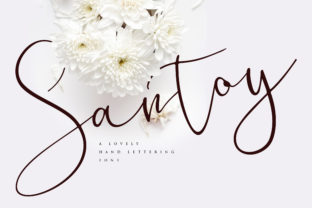
Santoy stands out in the crowded landscape of handwritten display fonts—not by being the most ornate or the most versatile, but by striking a rare balance: it feels effortlessly light on the page while carrying unmistakable presence. Designed for clarity and character, Santoy isn’t meant to mimic messy ink or chaotic script. Instead, it’s a carefully considered interpretation of confident handwriting—fluid, rhythmic, and intentionally uncluttered. Its value lies not in novelty alone, but in how reliably it performs across real design contexts where legibility, tone, and visual hierarchy matter.
What Makes Santoy Distinctive—Beyond “Handwritten”
Many handwritten fonts sacrifice readability for personality—or vice versa. Santoy avoids that trade-off. Its letterforms are open, with generous spacing between characters and consistent stroke contrast that supports quick scanning. The lowercase a, e, and s retain natural entry and exit strokes, reinforcing motion without sacrificing structure. Uppercase letters are tall and upright, lending authority without stiffness. There’s no excessive swash, no forced ligatures, and no artificial texture overlays—just clean, intentional shapes drawn with precision.
This restraint contributes directly to its bold feel. Because each glyph occupies space thoughtfully—and because the font includes only one weight (a true medium-bold) rather than a full variable axis—it avoids visual fatigue. Unlike lighter script fonts that disappear at small sizes or heavier ones that overwhelm, Santoy holds up well from 24px headlines down to 18px subheads in digital interfaces, and scales cleanly up to large-format print.
Practical Strengths in Real Projects
Santoy excels where tone and recognition intersect: brand identities for lifestyle brands, editorial features, product packaging for artisanal goods, and social media visuals targeting adult audiences who respond to authenticity over polish. A wellness coach launching a new course might use Santoy for their hero headline (“Your First Step Starts Here”) alongside a neutral sans-serif body font—creating warmth without informality. A small-batch coffee roaster could apply it to a limited-edition bag label, where its lightness reflects craft and care, and its boldness ensures shelf impact.
In UI contexts, Santoy works best as a controlled accent—not a system font. It’s been used effectively in dashboard welcome messages, email subject lines, and CTA buttons where brevity and emotional resonance matter more than dense information delivery. One freelance designer reported using Santoy consistently for client project titles in Notion workspaces; the font helped differentiate active initiatives visually while maintaining professional cohesion across dozens of pages.
Usability and Integration Considerations
Santoy ships as a standard OTF/TTF package with Latin-1 support, including basic punctuation, numerals, and accented characters used in Spanish, French, and German. It does not include extended Cyrillic, Greek, or Vietnamese glyphs—so multilingual publishing beyond Western European languages requires pairing or fallback planning. Kerning is tight and predictable, and the font renders consistently across modern browsers and major design tools (Figma, Adobe Creative Cloud, Sketch).
Its single-weight nature simplifies licensing and file management but limits typographic hierarchy options within a single-family system. Designers accustomed to working with multi-weight families may need to pair Santoy intentionally—for example, with Inter or Manrope for body text, or Clash Grotesk for supporting headings. That pairing isn’t a weakness; it’s an invitation to thoughtful composition. Santoy doesn’t try to do everything—it focuses on doing one thing exceptionally well.
Consistency and Long-Term Reliability
Unlike some free handwritten fonts that show inconsistent stroke widths or uneven baseline alignment across characters, Santoy maintains mechanical consistency without losing organic rhythm. Test prints at 300 DPI show no hint of pixelation or distortion, even in fine hairlines. On screen, it remains crisp on Retina and high-DPI displays—a practical advantage for creators delivering assets to clients or publishing directly to web platforms.
Its longevity stems from intentionality: it avoids trends like exaggerated bounce, artificial ink bleed, or forced irregularity. That means a logo or campaign built around Santoy today won’t look dated in two years. Educators using it in presentation decks, bloggers applying it to featured quote graphics, or small business owners choosing it for signage all benefit from that stability.
Who Benefits Most—and When to Pause
Santoy suits professionals who prioritize clarity and human tone without leaning into cuteness or casualness. Entrepreneurs building personal brands—coaches, consultants, makers—find it especially useful for conveying approachability paired with competence. Marketers running targeted campaigns for audiences aged 30–50 respond well to its balanced energy: familiar enough to feel accessible, distinct enough to stand out in feeds.
It’s less suited for long-form reading, data-heavy reports, or environments requiring strict accessibility compliance (e.g., WCAG AA contrast thresholds for body copy). While its contrast meets minimum standards for display use, it shouldn’t replace highly legible system fonts in interface text fields or paragraph blocks. Similarly, designers working on corporate rebrands with strict brand guidelines around formality may find Santoy too expressive for formal documentation—even if it works beautifully for external-facing campaigns.
Realistic Pairing and Workflow Tips
- For digital layouts: Use Santoy at 28–42px for headlines, always with at least 1.3 line-height. Pair with a neutral, highly legible sans-serif (e.g., IBM Plex Sans or Source Sans Pro) for supporting text.
- For print: Test output at actual size before finalizing. Its lightness can shift subtly depending on paper stock—matte finishes tend to preserve contrast better than glossy.
- For branding systems: Limit Santoy to one primary application per asset (e.g., logo lockup or headline treatment—not both). This preserves its impact and avoids visual competition.
- For accessibility: Always provide alt text for images featuring Santoy-based text, and never rely solely on color contrast to convey meaning in Santoy-rendered elements.
Santoy doesn’t promise transformation—it offers refinement. It won’t fix weak messaging or poor layout decisions. But when applied deliberately, it elevates intention. Whether you’re refining a landing page headline, designing a workshop handout, or developing a seasonal campaign, Santoy delivers a quiet confidence: light in execution, bold in effect, and reliable in outcome. Its strength isn’t in volume or variation, but in focus—and for many creators, that’s exactly what makes it worth keeping in rotation.