Ladybug: A Playful, Romantic Script Font
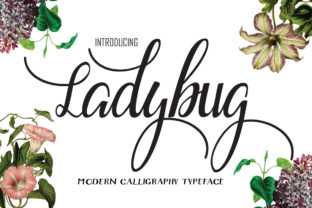
When you’re choosing a font for a wedding invitation, a boutique logo, or a heartfelt social media post, tone matters as much as content. Ladybug isn’t just another script font—it’s a carefully crafted typeface that balances elegance with approachability, romance with playfulness. Its flowing connections, subtle bounce, and gentle contrast give it a hand-drawn warmth without sacrificing readability or versatility. If you’ve ever hesitated to use script fonts because they felt too formal, too fragile, or too hard to pair, Ladybug offers a refreshingly grounded alternative.
Why Ladybug Stands Out in Real Design Work
Most romantic script fonts fall into one of two categories: highly ornate (think elaborate flourishes and tight spacing) or overly casual (loose, inconsistent, and difficult to scale). Ladybug sits thoughtfully between them. Its letterforms have personality—notice the soft curve on the lowercase “g,” the graceful entry stroke on “h,” or the slight upward tilt of the “t” crossbar—but none of it distracts from legibility at 14–24 pt sizes. That balance makes it unusually adaptable across mediums: printed stationery, digital banners, embroidered patches, or even engraved signage.
For Small Business Owners: Branding With Heart
Small business owners—especially those in wellness, floristry, artisan food, or handmade goods—often need branding that feels personal but still professional. Using Ladybug in a shop logo or packaging label adds emotional resonance without seeming gimmicky. One local candlemaker replaced their generic serif logo with Ladybug set in all caps for their brand name and paired it with a clean sans-serif for product descriptions. Customers reported the new look “felt like the brand finally sounded like them.” The font didn’t shout—but it invited closer attention.
For Educators and Content Creators: Making Warmth Intentional
Educators building digital course materials or educators designing classroom posters often default to safe, neutral fonts. But warmth builds trust—and trust improves engagement. A Montessori teacher used Ladybug for weekly “Learning Highlights” headers in her parent newsletter, keeping body text in a highly legible sans-serif. Parents responded positively not just to the content, but to the *feeling* the typography conveyed: care, intention, and joy in learning. Ladybug worked here because it was used sparingly and purposefully—not as decoration, but as emotional punctuation.
Where Ladybug Delivers Practical Value
It’s easy to overlook how much time gets lost adjusting tracking, kerning, or baseline alignment when working with finicky scripts. Ladybug was designed with consistent spacing and balanced weight distribution, so it performs well out of the box in tools like Canva, Adobe Express, and Figma—even without advanced typographic controls. You won’t need to manually nudge every “f” or “j” to avoid collisions. That saves 10–15 minutes per project, which adds up fast if you’re producing monthly newsletters, seasonal promotions, or client deliverables.
Its playful feel also helps reduce perceived friction in communication. A freelance copywriter noticed higher open rates on email subject lines set in Ladybug (used only for the first three words) compared to her usual sans-serif. Not because the font “converted better,” but because it signaled approachability—a quiet cue that the message inside wouldn’t be stiff or salesy. That kind of nuance is hard to engineer with other script fonts, which often lean either too precious or too cartoonish.
Who Benefits Most—and When to Pause
Ladybug shines brightest when the goal is connection over authority. It’s ideal for contexts where empathy, intimacy, or delight are part of the message: baby announcements, handwritten-style thank-you notes, boutique retail signage, Instagram story quotes, or editorial pull-quotes in lifestyle magazines. It’s less suited for legal disclaimers, technical documentation, or interfaces requiring rapid scanning—situations where clarity and neutrality take priority.
That said, don’t assume Ladybug only works for “feminine” brands. A male-owned woodworking studio uses it for their workshop name on tool rolls and business cards—paired with bold geometric sans-serifs and natural wood textures. The contrast feels intentional, human, and memorable—not clichéd. The key isn’t gendered association; it’s whether the voice behind the words values tenderness, authenticity, or gentle charm.
Pairing Ladybug Thoughtfully
Like any strong personality, Ladybug benefits from thoughtful companionship. Avoid pairing it with other decorative or high-contrast scripts—that creates visual competition. Instead, try it with:
- A warm, low-contrast sans-serif (e.g., Poppins Light, Lato Regular) for body text or captions—this keeps hierarchy clear while preserving warmth.
- A sturdy, slightly rounded grotesque (e.g., Inter Medium or Manrope SemiBold) for buttons or callouts—adds modern grounding without coldness.
- A single accent serif (e.g., Cormorant Garamond Italic) for short quotes or signatures—introduces subtle tradition without overwhelming.
Avoid ultra-thin weights, ultra-condensed fonts, or anything with aggressive ink traps or sharp serifs. Those clash with Ladybug’s soft rhythm. And if your project requires multilingual support beyond basic Latin characters, check whether the Ladybug family includes extended language sets—some versions stop at Western European glyphs, which may limit use in global-facing materials.
Realistic Expectations: What Ladybug Won’t Do
Ladybug won’t magically fix weak messaging or compensate for poor layout. It won’t make low-resolution print jobs look crisp, nor will it ensure accessibility compliance on its own (always test contrast ratios and provide alt text for image-based uses). It also doesn’t replace the need for thoughtful hierarchy—if you set entire paragraphs in Ladybug, readers will tire quickly. Its strength lies in moments of emphasis, not endurance.
And while it’s more versatile than many script fonts, it’s not a universal solution. If your brand voice leans toward tech-forward, minimalist, or institutional, Ladybug may feel tonally misaligned—no matter how beautifully rendered. In those cases, consider whether a lighter-weight sans-serif with subtle calligraphic influence (like Quicksand or Playfair Display Italic) might serve similar warmth goals with broader stylistic compatibility.
Ultimately, Ladybug earns its place not by being the most dramatic or technically complex script font—but by being reliably expressive, consistently legible, and quietly confident in its charm. It doesn’t ask to be the center of attention. It simply makes the things you care about feel a little more human—and that, for many creators, is exactly the kind of support worth building around.