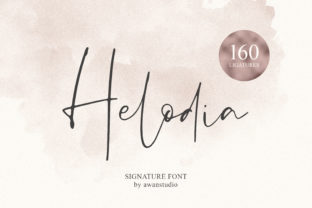
Helodia: A Handwritten Font with Contemporary Intelligence
When you need handwriting that feels personal but polished—authentic yet intentional—Helodia stands apart. It’s not just another script font scraped from a calligrapher’s notebook. Helodia is a carefully engineered handwritten typeface designed for real-world use: it balances organic flow with typographic precision, includes intelligent ligatures that activate contextually, and carries a subtle contemporary edge that keeps it fresh across digital and print applications.
Why handwriting fonts matter more than ever
In an age of algorithmic feeds and templated interfaces, human texture cuts through noise. A well-chosen handwritten font like Helodia signals care, individuality, and intention—not just decoration. But not all script fonts deliver reliably. Many break down at small sizes, lack spacing consistency, or feel dated or overly casual. Helodia was built to avoid those pitfalls: its letterforms are open and legible even at 14pt, its baseline alignment is stable across weights, and its rhythm supports both short headlines and longer passages—like event invitations, product packaging copy, or educator handouts.
Smart ligatures that work—not just impress
Helodia includes over 80 contextual ligatures, but they’re not decorative flourishes. They’re functional refinements: “fi”, “fl”, “ct”, and “st” connect smoothly without crowding; “Th”, “Qu”, and “Ch” resolve cleanly in uppercase settings; and alternate swashes appear only where they enhance readability—not overwhelm it. In practice, this means less manual kerning when designing logos or social media banners. For a freelance designer building a brand identity for a local ceramic studio, Helodia’s ligatures help unify the logo, website headline, and Instagram story text—without needing separate custom lettering for each format.
Where Helodia delivers measurable value
Consider a small business owner launching a new line of herbal teas. They need packaging that conveys warmth and craftsmanship—but also must pass regulatory requirements (ingredient lists, net weight) and shelf-readability tests. Helodia’s Regular weight handles primary branding beautifully; its Light variant works for fine-print details without sacrificing character; and its consistent x-height ensures that “organic chamomile” remains legible beside bold “CALM” headers. No font swapping. No compromises.
For educators creating classroom resources, Helodia offers a rare advantage: it reads like friendly handwriting without triggering dyslexia-related decoding challenges. Its letterforms avoid ambiguous shapes (no confusing “a”/“o” or “l”/“1” collisions), and its generous counters improve scanning speed. One Montessori teacher reported students engaged more deeply with reading comprehension worksheets set in Helodia versus generic cursive fonts—likely due to reduced visual friction, not novelty.
Who benefits most—and why
- Content creators who design their own newsletters, Canva templates, or Notion dashboards find Helodia speeds up iteration. Its OpenType features work natively in Figma, Illustrator, and modern web platforms—no plugin required.
- Marketers running seasonal campaigns appreciate how Helodia adapts: switch from a restrained Light weight for email body copy to Bold for hero banners, all while preserving voice and cohesion.
- Bloggers and authors using WordPress or Ghost can embed Helodia via variable font files, serving lighter subsets to mobile users—improving load time without sacrificing expressiveness.
- Freelance designers billing by the hour value Helodia’s predictability. Fewer revisions mean faster client sign-offs—especially on projects where “handmade” tone is non-negotiable (wedding suites, artisanal labels, indie publishing).
Realistic fit considerations
Helodia excels where personality and clarity coexist—but it isn’t universal. It’s not ideal for dense legal disclaimers, multilingual interfaces requiring extensive diacritics (though it supports Western European languages well), or ultra-minimalist brands leaning into strict geometric sans-serifs. If your project demands extreme scalability—from billboard to app icon—it’s worth testing Helodia alongside a complementary sans-serif (like Inter or Manrope) for hierarchy. Also, while its variable weight axis offers flexibility, users relying on legacy software may need static OTF/TTF files instead of the full variable font.
Practical tips for stronger results
Start simple: apply Helodia to one high-impact element first—your site’s main headline, a signature section divider, or the “From the Founder” note in your email footer. That builds confidence before expanding usage. Pair it thoughtfully: its warmth pairs naturally with neutral sans-serifs (not other scripts), and its contrast works best against ample whitespace—not busy backgrounds.
Use its stylistic sets deliberately. Helodia includes three distinct swash options—Subtle, Expressive, and Editorial—each activated via OpenType features. The Subtle set adds quiet refinement to product names; Expressive suits celebratory contexts (birth announcements, launch graphics); Editorial offers restrained alternatives for longer text blocks where flair might distract. Toggle them in real time rather than guessing which looks “right.”
Not just aesthetics—functional empathy
What makes Helodia different isn’t just how it looks, but how it behaves under pressure: when a blogger needs to update a post last-minute, when a teacher prints 30 copies before class, when a startup founder tweaks packaging for a retailer’s spec sheet. Its engineering reflects an understanding that typography serves people—not just pixels or print runs. That shows in the even ink traps, the balanced stroke contrast, the way lowercase “g” and “y” descend cleanly without clipping adjacent lines.
It won’t replace strategic thinking or thoughtful content—but it removes friction between intention and execution. When your message deserves attention, Helodia helps ensure it’s received, not just seen.
Getting started, responsibly
If you’re evaluating Helodia for a current project, test it with your actual copy—not placeholder text. Try it in your intended environment: paste into your CMS preview, mock it up in your design tool at final size, print a sample if physical output matters. Notice where ligatures engage naturally and where spacing tightens unexpectedly. Compare it side-by-side with two alternatives—one purely functional (e.g., a clear sans-serif), one emotionally similar but less refined (a free script font). The difference often reveals itself in endurance: how well it holds up after five minutes of reading, not five seconds of scrolling.
Helodia earns its place not by shouting, but by listening—to the needs of readers, creators, and the quiet demands of good communication.