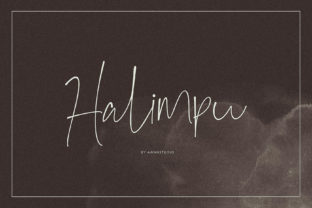
Halimpu: A Handwritten Font with Contemporary Character and Design Flexibility
Halimpu is a carefully crafted handwritten font that balances organic flow with modern legibility. Unlike many script fonts that lean heavily into ornate flourishes or rigid calligraphic structure, Halimpu offers a relaxed yet intentional rhythm—its letterforms feel human-made but remain consistent enough for extended use in branding, editorial layouts, and digital interfaces. It’s not just “hand-drawn”; it’s thoughtfully spaced, kerned, and weighted to perform across sizes and contexts.
What Sets Halimpu Apart From Other Handwritten Fonts
Many handwritten fonts fall into one of two categories: highly decorative (often difficult to read at small sizes or in body text) or overly casual (lacking the polish needed for professional applications). Halimpu occupies a middle ground. Its lowercase letters feature subtle variation in stroke width and natural entry/exit terminals, while its uppercase characters maintain presence without dominating. The spacing between letters avoids both cramped tightness and excessive airiness—a practical consideration when setting headlines or short quotes.
One distinguishing trait is Halimpu’s approach to connectivity. It includes optional ligatures and contextual alternates, but doesn’t force continuous cursive flow. This gives designers control: you can use it as a fully connected script for elegance, or disable connecting features for a more segmented, contemporary look—ideal for logos where clarity trumps flourish.
Fitness for Real-World Design Tasks
Halimpu works well in situations where authenticity and approachability matter—think boutique brand identities, artisanal product packaging, lifestyle blog headers, or invitation suites. Its warmth helps soften minimalist layouts without clashing with clean sans-serif pairings. For example, pairing Halimpu with a neutral geometric sans like Inter or Manrope creates visual contrast that feels intentional rather than accidental.
It’s less suited for long-form body text—no handwritten font truly excels there—but it holds up better than most in short paragraphs or pull quotes. In UI contexts, Halimpu shines in hero sections, on-call-to-action buttons, or microcopy where tone matters more than density. Just avoid using it below 16px in web interfaces unless testing confirms readability for your audience.
Comparing Halimpu With Broader Handwritten Categories
Handwritten fonts generally fit into three functional groupings: display-focused, versatile hybrids, and utility-oriented. Halimpu sits firmly in the versatile hybrid category. Display fonts often prioritize aesthetic impact over adaptability—they’re stunning at 60pt but break down at 24pt. Utility fonts tend toward simplified, almost monoline forms that sacrifice character for consistency. Halimpu bridges those poles: it retains personality at larger sizes and remains legible and stable at moderate sizes.
This balance affects file size and technical implementation too. Halimpu is typically delivered as a standard OpenType font (OTF or TTF), supporting common typographic features like stylistic sets and language-specific glyphs. It doesn’t require complex variable font setup or custom rendering—making it accessible to designers using Figma, Adobe Creative Cloud, or basic CSS @font-face declarations.
Strengths and Practical Tradeoffs
Strengths:
- Natural rhythm without sacrificing structural coherence
- Strong visual identity that supports brand differentiation
- Good cross-platform rendering on macOS, Windows, and iOS
- Light weight variation (where available) adds flexibility for hierarchy
- Works effectively in both print and digital, especially when used intentionally
Tradeoffs to consider:
- Limited language support compared to system fonts—verify coverage for non-Latin scripts if needed
- No built-in italics or bold weights in all versions; some releases offer only regular weight
- May require manual kerning adjustments in specific letter combinations (e.g., “r” + “o”, “f” + “l”) depending on the software used
- Less suitable for data-heavy dashboards, technical documentation, or accessibility-critical interfaces where high contrast and predictability are essential
When Halimpu Fits—and When It Doesn’t
Halimpu fits best when your goal is to communicate warmth, creativity, or personal craftsmanship. A ceramic studio launching a new collection might use Halimpu for product names and taglines—its slight irregularity echoes hand-thrown forms. A wellness coach building a website could apply it to section headers and testimonial quotes, reinforcing sincerity without seeming generic.
It becomes less appropriate when neutrality, speed, or broad accessibility are top priorities. Government outreach materials, academic journal titles, or enterprise SaaS dashboards usually benefit from higher legibility thresholds and stricter typographic conventions—contexts where even refined handwritten fonts can introduce unnecessary cognitive load.
Also consider audience expectations. Younger demographics often respond well to expressive typography like Halimpu in social-first campaigns. Older or more conservative audiences may perceive it as informal or unpolished unless balanced carefully with strong supporting type and layout discipline.
Pairing Halimpu Thoughtfully
Successful pairing isn’t about contrast alone—it’s about shared intention. Halimpu pairs well with typefaces that share its humanist sensibility but provide structural counterbalance. A warm, slightly rounded sans-serif (like Quicksand or Work Sans) complements its softness without competing. A crisp, high-x-height serif (such as Merriweather or PT Serif) can anchor Halimpu’s fluidity in editorial settings.
Avoid pairing it with other highly decorative scripts—this risks visual noise. Similarly, extremely narrow or condensed sans-serifs often clash with Halimpu’s generous proportions. If using it in motion graphics or video overlays, test timing: its natural pacing benefits from slightly longer display durations than ultra-sleek display fonts.
Evaluating Alternatives Based on Need
If Halimpu’s particular blend of looseness and control doesn’t align with your project’s requirements, consider evaluating alternatives along these dimensions:
- Legibility priority? Look for semi-script fonts with open counters and reduced stroke variation—fonts designed for signage or wayfinding often translate well to digital use cases requiring clarity.
- Language breadth needed? Check glyph coverage early. Some handwritten fonts include only basic Latin-1, while others extend to Central European, Cyrillic, or Greek characters.
- Variable weight access required? If your design system depends on responsive weight shifts (e.g., bolder on hover, lighter in captions), confirm whether Halimpu—or an alternative—offers true variable axes or relies on static files.
- Licensing scope? Verify usage rights for intended platforms: web embedding, mobile app bundling, and commercial merchandise may have different restrictions, even within the same foundry.
None of these factors make Halimpu “better” or “worse”—they simply define where it operates most effectively. The strongest typography decisions come not from chasing trendiness, but from matching tool to task, audience to tone, and constraint to capability.
Making a Confident Choice
Halimpu stands out because it doesn’t try to be everything. It embraces its nature as a handwriting-inspired typeface while respecting real-world constraints: screen resolution, translation needs, production timelines, and user expectations. That focus makes it easier to evaluate objectively—not as a “must-have,” but as a considered option among many.
Before committing, test it in your actual environment: set real copy, view it on target devices, and ask colleagues or users what impression it conveys. Does it feel aligned with your message? Does it hold up under scrutiny? Does it serve the reader—or draw attention to itself unnecessarily? These questions matter more than stylistic novelty.
In the end, Halimpu earns its place not through flash, but through thoughtful execution. It’s a tool that rewards restraint, invites intentionality, and supports design decisions rooted in purpose—not just preference.