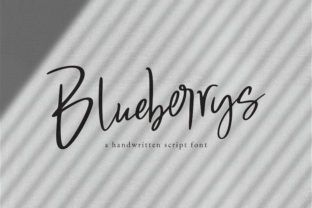
Blueberrys: A Modern Handwritten Font for Contemporary Design
Blueberrys is a modern, light handwritten font designed with a distinctive, relaxed rhythm and subtle irregularity. Unlike traditional script fonts that mimic formal calligraphy, Blueberrys embraces an informal, contemporary aesthetic—characterized by airy spacing, gentle stroke contrast, and a natural flow that suggests spontaneity without sacrificing legibility. It was crafted to serve design contexts where warmth, approachability, and current visual sensibility are priorities.
For designers, branding professionals, and content creators evaluating typefaces, Blueberrys represents one option among many in the growing category of “friendly sans-serif-adjacent scripts.” Its appeal lies not in technical versatility or historical pedigree, but in its ability to convey authenticity and lightness in carefully curated applications.
Why Consider Blueberrys?
Designers often seek typefaces that reinforce tone and intention without competing for attention. Blueberrys may stand out during evaluation for several practical reasons:
- Distinctive voice: Its uneven baseline, slight variations in letter height, and soft terminals differentiate it from more uniform handwritten fonts—offering visual interest without appearing overly decorative.
- Light weight and openness: The font’s low stroke density and generous x-height contribute to readability at larger sizes, especially on screen or in print layouts with ample white space.
- Contemporary alignment: Blueberrys avoids nostalgia or retro cues. It reads as current—not tied to a specific era—making it adaptable across digital interfaces, editorial features, or brand identity systems aiming for freshness.
These qualities make Blueberrys relevant when the goal is to soften hierarchy, humanize messaging, or introduce subtle personality into otherwise minimal layouts.
Where Blueberrys Performs Well
Blueberrys is most effective in controlled, intentional settings. It excels in roles where typographic presence supports rather than dominates:
- Logo wordmarks and sub-brands: Particularly for lifestyle, wellness, creative services, or education-focused brands seeking an unpretentious yet polished impression.
- Editorial accents: Use as a display face for pull quotes, section headers, or chapter titles in magazines, blogs, or digital publications with clean, spacious layouts.
- Short-form digital content: Social media graphics, email headers, or landing page hero text—especially when paired with a neutral sans serif for body copy.
In these cases, Blueberrys functions as a deliberate stylistic choice—not a default. Its strength emerges when used sparingly and with purpose, reinforcing a cohesive visual language rather than attempting to carry extended text.
Limits and Practical Considerations
Like any specialized font, Blueberrys comes with functional constraints worth acknowledging before integration:
It lacks extensive language support and does not include OpenType features such as stylistic alternates, ligatures, or small caps. This limits flexibility in multilingual projects or typographically nuanced publishing workflows. Additionally, Blueberrys is not optimized for long-form reading. Its irregular rhythm and light weight reduce legibility in paragraphs or dense UI components—especially at smaller sizes or on lower-resolution screens.
Users should also consider licensing scope. Blueberrys is typically offered under desktop and web licenses with distinct usage terms. Projects requiring variable font functionality, custom embedding (e.g., in mobile apps), or extensive redistribution (such as SaaS platforms) may need verification that the license covers those use cases.
Another consideration is pairing. Blueberrys pairs best with highly legible, neutral sans serifs—think Inter, Manrope, or IBM Plex Sans—that provide structural balance without visual competition. Avoid pairing it with other expressive or high-contrast fonts, which can create tonal dissonance.
When Alternatives May Be More Suitable
Blueberrys is not universally appropriate. Evaluate alternatives if your project requires any of the following:
- Extended text settings: For body copy, documentation, or interface labels, a well-designed system font or robust text face (e.g., Roboto, Lato, or Source Sans Pro) will deliver greater consistency and accessibility.
- High-contrast or formal expression: If your brand leans toward elegance, luxury, or tradition, fonts like Playfair Display, Cormorant Garamond, or even a refined script like Pacifico may better match that voice.
- Technical adaptability: Projects needing variable axes (weight, width, optical size), comprehensive character sets (including Cyrillic or Vietnamese), or advanced typographic controls benefit from fonts built with those capabilities in mind—such as Recursive, IBM Plex, or Nunito.
Also consider budget and tooling. Some alternatives offer free, open-source licenses with broad permissions; Blueberrys may require purchase or subscription depending on source and intended use. Verify compatibility with your design stack (Figma, Adobe apps, CSS @font-face workflows) before committing.
Making a Practical Decision
Choosing Blueberrys—or passing on it—should follow a short sequence of objective checks:
- Define the role: Is this for a headline, logo, or accent? If the answer is “body text” or “navigation label,” Blueberrys is unlikely to meet functional needs.
- Assess the audience and context: Will readers encounter it on mobile? In a printed brochure? As part of an accessible website? Test real usage—not just mockups—to gauge clarity and tone.
- Compare against alternatives side-by-side: Render Blueberrys alongside two or three comparable fonts at identical sizes and weights in your actual layout. Note differences in rhythm, spacing, and how comfortably it coexists with supporting type.
- Review licensing and technical fit: Confirm the license permits your deployment method (web, app, PDF export) and that file formats (WOFF2, OTF) integrate smoothly into your pipeline.
Finally, recognize that typography choices reflect values as much as aesthetics. Blueberrys signals informality, lightness, and modern ease—but those qualities must align with your communication goals. A font that feels “on-brand” in isolation may weaken clarity or trust if mismatched to audience expectations or platform constraints.
In summary, Blueberrys serves a specific niche: designers seeking a fresh, handwritten-inspired display face that balances personality with restraint. It is neither a utility font nor a universal solution—but in the right context, it contributes meaningfully to tone, differentiation, and visual cohesion. Evaluating it thoughtfully—against concrete requirements, not just visual preference—helps ensure the choice supports, rather than complicates, the work ahead.