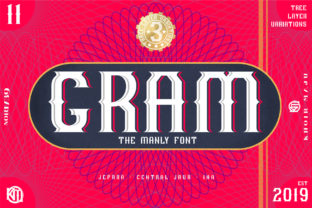
Gram: Vintage Blackletter, Modern Impact
If you’ve ever scrolled past a logo, poster, or social post and paused—just for a beat—because the typography felt both timeless and unmistakably fresh, there’s a good chance Gram was at work. It’s not just another blackletter font. Gram is a carefully balanced reinterpretation: bold enough to command attention, refined enough to avoid visual fatigue, and subtle enough to feel intentional—not nostalgic for nostalgia’s sake.
Unlike many blackletter typefaces that lean heavily into gothic density or calligraphic flourish, Gram breathes. Its letterforms retain structural integrity and legibility at small sizes—something rare in the genre—while preserving the textured rhythm and angular confidence that define authentic blackletter tradition. The contrast between thick vertical strokes and delicate hairlines is calibrated for screen and print alike. And crucially, it avoids the “costume” effect: Gram doesn’t scream “medieval fair” or “heavy metal album.” It whispers craft, authority, and quiet distinction.
Where Gram Fits—and Why It Sticks
Typography isn’t decoration. It’s infrastructure for meaning. When your audience spends less than two seconds deciding whether to engage, the right font can quietly tip the balance. That’s where Gram earns its place—not as a novelty, but as a strategic tool.
Consider a boutique coffee roaster launching a new single-origin line. A clean sans-serif might communicate modernity—but not warmth, heritage, or care. A script font could feel too casual or overly ornate. Gram bridges that gap: strong enough for a bag label or storefront sign, nuanced enough for a tasting note card or Instagram story overlay. It signals tradition without rigidity, craftsmanship without pretension.
Same logic applies across contexts:
- Educators use Gram in workshop handouts or course branding to evoke scholarly weight—without intimidating students. Its clarity at 14–16pt makes it viable for printed syllabi or slide headers.
- Freelance designers layer Gram over muted photography for client pitch decks. It adds texture and personality without competing with imagery—especially when used sparingly (e.g., section titles or pull quotes).
- Bloggers and newsletter writers apply Gram to featured article headlines or signature section dividers. Paired with a neutral body font like Inter or Lora, it creates visual hierarchy that feels editorial, not cluttered.
- Small business owners integrate Gram into invoice footers, packaging stamps, or email signature lines. It reinforces brand voice consistently—even in low-attention spaces.
Real Use, Not Just Real Fonts
What sets Gram apart isn’t just how it looks—it’s how it behaves. It ships with OpenType features including stylistic alternates, ligatures, and case-sensitive forms. That means you’re not stuck with one rigid version of “A” or “f.” You can fine-tune rhythm and spacing based on context: swap in a more open alternate for tight headline tracking, or activate discretionary ligatures for elegant word endings in logos.
It also includes robust language support—covering Latin Extended-A, Vietnamese, and basic Cyrillic—so it works reliably for multilingual content without fallback surprises. No awkward character substitutions mid-sentence. No last-minute font swaps before a client presentation.
And yes—it performs well digitally. Gram renders cleanly on iOS, Android, and major desktop browsers. Its hinting is optimized for readability at 18px and above in UI elements, and its variable weight axis (where available) allows smooth transitions between display and functional use—say, from a bold landing page hero to a medium-weight navigation label.
Practical Tips Before You Type
Gram rewards intentionality. Here’s what seasoned users consistently notice:
- Less is more—especially with size and weight. Use Gram at 24px minimum for body-level text (like pull quotes), and reserve heavier weights (Gram Bold or Black) strictly for short, high-impact applications: logos, chapter titles, or event posters. Overuse dilutes its impact and strains readability.
- Pair deliberately. Gram thrives beside humanist sans-serifs (like Poppins or Manrope) or low-contrast serifs (like Merriweather or EB Garamond). Avoid pairing it with other high-contrast or decorative fonts—that creates visual noise, not harmony.
- Test contrast early. While Gram’s design improves legibility, light-on-dark usage (e.g., white Gram text on navy) demands extra care. Check luminance contrast ratios—especially for accessibility compliance. A 4.5:1 ratio is baseline; aim for 7:1 if possible for small caps or fine details.
- Think beyond English. If your project targets global audiences, verify glyph coverage for diacritics you actually need—not just those listed in the spec sheet. Test “naïve,” “résumé,” and “Müller” in your layout software before finalizing.
When Gram Isn’t the Answer
Honesty matters. Gram excels in expressive, identity-driven roles—but it’s not universal. Avoid it for long-form web copy, data tables, legal disclaimers, or interfaces requiring rapid scanning. Its character density slows reading velocity compared to optimized UI fonts. Likewise, skip Gram for brands built entirely on minimalism, tech-forward aesthetics, or playful youthfulness—unless you’re intentionally subverting expectations (and have the visual strategy to back it up).
Also worth noting: licensing. Gram is typically offered under commercial-use licenses, but always confirm permissions for your specific use case—especially for SaaS platforms, embedded apps, or merchandise resale. Some versions include web font hosting; others require self-hosting with proper CORS configuration. Don’t assume “downloaded = ready.”
A Font That Earns Its Space
In an era where attention is fragmented and authenticity is currency, typography choices carry quiet weight. Gram doesn’t shout. It settles in—confident, considered, and cohesive. Whether you’re redesigning a teacher’s classroom website, crafting a wedding invitation suite, or building a Shopify store for handmade ceramics, Gram offers something increasingly rare: distinction without distraction.
It’s the kind of typeface that makes people pause—not because it’s loud, but because it feels *right*. And in design, that’s the highest compliment you can earn.