Wringkle in Time: A Charming Serif Font
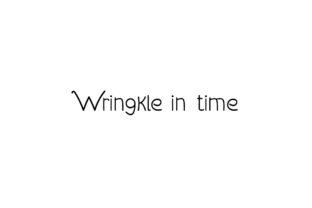
There’s a quiet confidence in Wringkle in Time — not loud, not flashy, but unmistakably present. It’s a serif font that feels like a well-worn book jacket: soft at the edges, thoughtful in structure, and deeply inviting. Designed with gentle contrast, open apertures, and subtle stroke modulation, it balances tradition with approachability. The letterforms breathe easily, with generous x-heights and friendly terminals that soften its classical roots. It’s not a revival of a historical typeface, nor is it aggressively modern — it occupies a warm middle ground where clarity meets character.
Where Wringkle in Time Finds Its Rhythm
This isn’t a font that tries to do everything. And that’s its strength. Wringkle in Time shines brightest as a display font — think book covers, greeting cards, boutique packaging, editorial mastheads, or small-batch product labels. Its charm comes through most clearly at sizes 24pt and up, where its delicate serifs and balanced proportions settle into place. You’ll see it used thoughtfully on ceramic mugs for a local café, embroidered onto linen tea towels, or set in tight columns for a literary zine’s title page.
It works less effectively for dense body text in long-form web articles or mobile interfaces where screen resolution and reading fatigue matter more. That’s not a limitation — it’s intention. Like choosing a hand-thrown mug over a mass-produced tumbler, Wringkle in Time signals care in context. When used for short, meaningful bursts — a tagline, a chapter heading, a logo lockup — it adds warmth without sacrificing polish.
How It Shapes Perception — Without Saying a Word
Typography is one of the first things people absorb about your brand — before they read a single sentence. Wringkle in Time communicates sincerity, craftsmanship, and calm attention to detail. It doesn’t shout “innovation” or “disruption,” but it does say, “We made this with care.” That resonates powerfully with audiences who value authenticity — independent publishers launching a poetry chapbook, makers selling handmade soaps online, or wellness coaches building a serene visual identity.
In editorial design, pairing Wringkle in Time with a clean, neutral sans serif (like Inter, Lato, or even a restrained version of Helvetica Neue) creates natural hierarchy: the serif draws the eye to what matters most, while the sans handles supporting information with quiet efficiency. In packaging design, its presence signals quality without leaning into luxury clichés — no gold foil required. And because it avoids both rigid formality and casual informality, it helps brands avoid looking either stiff or overly trendy.
Testing Fit Before Committing
Before adding Wringkle in Time to your project, ask two practical questions: What emotion am I trying to evoke? and Where will this be seen first? If your answer leans toward “trust,” “thoughtfulness,” or “handmade integrity,” and the context is visual-first — a social media banner, a printed invitation, or a storefront sign — it’s likely a strong candidate.
Try setting your core phrase in Wringkle in Time at three sizes: 36pt, 24pt, and 18pt. Print them out or view them on a tablet. Does the rhythm hold? Do letters like “a,” “e,” and “g” feel legible and distinct? Does the spacing between words feel even, or does it bunch up in certain combinations? These aren’t theoretical concerns — they’re the difference between a headline that lingers in memory and one that blurs into the background.
Pairing With Purpose — Not Just Contrast
Good font pairing isn’t just about opposites attracting. It’s about shared values. Wringkle in Time pairs best with sans serifs that share its humanist sensibility — ones with open counters, modest stroke variation, and even color. Avoid ultra-geometric or high-contrast sans serifs (think Futura Bold or Montserrat Black), which can clash tonally. Instead, try it alongside fonts like Poppins (Light or Regular), Nunito, or Source Sans Pro — all of which support rather than compete.
You’ll also find it plays nicely with understated script fonts — not ornate calligraphic ones, but something like Cormorant Garamond Italic or Playfair Display Italic — when you need a touch of movement or emphasis without breaking cohesion. The key is restraint: one serif, one supporting voice, and space to let both breathe.
Licensing, Styles, and Real-World Practicalities
Wringkle in Time is typically offered as a commercial font — meaning it’s licensed for use in client work, products you sell, or branding assets you build professionally. Always verify licensing terms before using it in a logo or app interface, especially if distribution is involved (e.g., embedding in a SaaS dashboard or downloadable PDF template). Most reputable foundries offer clear, tiered licenses — personal, small business, and extended — so match the scope of your project to the right tier.
Check what weights and styles are included. A robust family might offer Regular, Italic, Medium, and Bold — enough for layered hierarchy without needing to fake boldness or slant. If only Regular and Italic are available, plan accordingly: use size, color, or spacing to create visual weight instead of relying on heavier weights.
Also consider language support. If your audience includes readers of accented European languages (French, Spanish, German), confirm that diacritics and ligatures render cleanly. Some charming serif fonts skimp here — Wringkle in Time generally includes solid Latin-1 coverage, but double-check if you’re typesetting names like “José” or “Müller” regularly.
A Final Thought — Typography as Tone
Wringkle in Time won’t fix weak messaging or unclear strategy. But when your words are thoughtful and your intent is genuine, it becomes a quiet amplifier — reinforcing tone, deepening connection, and lending credibility through craft. It’s the kind of font that makes people pause, just for a beat, because something feels *right*. Not flashy. Not forced. Just quietly, confidently human.
If you’re designing a wedding suite, launching a slow-fashion label, writing a memoir, or building a newsletter focused on mindful living — Wringkle in Time is worth testing. Not as a default, but as a considered choice. One that says, without shouting: This matters. You matter. Let’s begin here.