The Secret Door
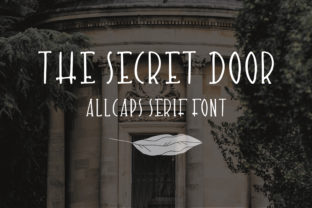
There’s something quietly magnetic about The Secret Door: a handwritten font in all caps that doesn’t try to be perfect—and that’s exactly why it works so well. It’s not polished like a corporate sans serif, nor does it mimic calligraphy with flourishes. Instead, it feels like someone quickly jotted down a phrase on a napkin, then carefully traced it—slight wobbles, uneven spacing, and subtle variations in letter thickness included. That imperfection isn’t a flaw; it’s the personality. It’s warm, approachable, and confidently unrefined—ideal for projects where authenticity matters more than austerity.
A Display Font With Heart, Not Just Hype
The Secret Door is a premium display font—not meant for body text, but built for moments that need emphasis, emotion, or invitation. Think of it as the visual equivalent of leaning in during a conversation: it draws attention without shouting. Its all-caps structure gives it presence, while its irregular baseline and organic stroke weight keep it from feeling rigid or robotic. It’s neither a script font nor a traditional serif font—it occupies its own gentle middle ground: a modern handwritten font with clear editorial sensibility.
This isn’t a font you’d use for a legal disclaimer or a data-heavy dashboard. But for a boutique bakery’s chalkboard sign, a limited-edition zine cover, or the “Join Us” headline on a community newsletter? Absolutely. Its charm lies in context: it thrives where human voice and tactile feeling matter—where readers aren’t scanning for facts, but pausing to connect.
Where It Fits—And Where It Doesn’t
Real-world usage reveals The Secret Door’s sweet spots. In brand identity, it shines for small businesses with strong local roots—think independent bookshops, ceramic studios, or neighborhood wellness studios. Paired with a clean, neutral sans serif (like Inter or Poppins) for supporting text, it creates contrast that feels intentional, not chaotic.
In editorial design, it adds warmth to magazine pull quotes, section headers in illustrated essays, or title treatments for personal essay collections. For packaging design, it lends handmade credibility to soap labels, tea tins, or candle boxes—especially when printed on textured paper or foil-stamped. On social media graphics, it stands out in Instagram story banners or Pinterest pins where boldness and legibility at smaller sizes still hold up (thanks to generous x-height and open counters).
It’s less effective in dense UI interfaces, long-form web copy, or multilingual layouts with complex diacritics—its character set is focused, not expansive. And while it scales beautifully to large print, avoid using it below 24pt in digital contexts without testing first: some letters tighten up in tight spaces, and spacing can feel cramped at very small sizes.
Pairing It Thoughtfully
Font pairing isn’t about rules—it’s about rhythm. With The Secret Door, aim for balance: contrast its looseness with structure, not competition. A geometric sans serif (like Montserrat or Work Sans) grounds it without dulling its energy. Avoid other handwritten or script fonts nearby—they’ll clash tonally, like two people talking over each other.
Try this combo: The Secret Door for headlines or logo lockups, paired with a slightly warmer neutral (say, Lato or Nunito) for body copy. In print, consider using a light-weight serif (such as Adobe Garamond or EB Garamond) for captions—its classic texture complements rather than competes.
Test pairings at actual size and in real context. Paste your headline + paragraph into a mockup of your website header or Instagram post. Does the hierarchy feel clear? Does the tone stay consistent across both fonts? If the handwritten font overwhelms or confuses the message, scale back—not by ditching it, but by adjusting weight, size, or spacing.
Licensing, Legibility, and Long-Term Use
The Secret Door is a commercial font, meaning it requires a license for business use—including client work, product packaging, or social media assets tied to revenue. Most vendors offer perpetual desktop licenses, and many include web font files for self-hosted sites (just double-check the EULA). If you’re designing for a client, confirm whether their license covers your usage—or if you’ll need to purchase an extended version.
Legibility hinges on environment. In high-contrast print (black ink on cream stock), it reads effortlessly—even at 36pt. On screen, ensure sufficient line height and padding around the text block. Avoid placing it over busy photos or low-contrast gradients; it needs breathing room to land.
One practical tip: test readability with actual users—not just designers. Show a sample to a friend who doesn’t work in design and ask, “What’s the first thing you notice?” and “What would you expect this brand to sell or stand for?” Their answers often reveal more than any style guide.
When Simplicity Serves Strategy
Here’s what experienced designers know: a font like The Secret Door isn’t about decoration. It’s a strategic shorthand. When your audience sees it, they subconsciously register cues—handmade, sincere, unhurried, human-scaled. That shapes perception before a single word is read.
For a podcast about slow living, it signals intentionality. For a nonprofit’s annual report, it softens institutional gravity without sacrificing seriousness. For a wedding invitation suite, it replaces formality with familiarity. None of those uses require explanation—because the typeface does quiet, confident work on its own.
That said, consistency matters. If you use The Secret Door for your logo, carry it through one or two key touchpoints—your website hero banner, your email header—but resist spreading it across every button, tab, and footer. Overuse dilutes its impact and blurs visual hierarchy. Let it breathe. Let it mean something specific.
Ultimately, The Secret Door earns its place not by being versatile in every situation, but by being unforgettable in the right ones. It won’t solve weak messaging or poor layout—but in the hands of a thoughtful creator, it deepens connection, clarifies voice, and quietly reinforces what makes a project feel like it belongs to a person, not a template.