The Karrs Script
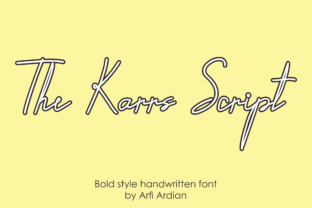
There’s a quiet shift happening in how we communicate visually—not through algorithms or AI-generated templates, but through the unmistakable presence of human gesture. The Karrs Script is part of that shift: a bold and authentic handwritten font designed not to mimic perfection, but to carry intention, warmth, and individuality. It doesn’t try to disappear into the background. Instead, it invites attention—gently, confidently, and without apology.
What Makes This Handwritten Font Different?
Most script fonts fall into one of two categories: overly ornate (with flourishes that distract) or overly restrained (flattened by digitization until they feel sterile). The Karrs Script avoids both traps. Its strokes vary in weight and rhythm in ways that echo natural handwriting—slight hesitations, confident lifts, subtle tapering—but remain highly legible at scale. That balance matters. A logo set in The Karrs Script reads clearly on a mobile screen. A social media quote using it feels personal, not performative. A product label set in it conveys craft without leaning into cliché.
Unlike many “handwritten” fonts generated from traced vectors or AI interpolation, The Karrs Script was drawn by hand first—then refined with precision, not erased of its humanity. That origin shows up in details: the way the lowercase g loops with quiet confidence, how the capital T anchors a line without rigidity, or how spacing between letters breathes just enough to avoid crowding. These aren’t arbitrary choices—they’re responses to real-world use cases where tone and clarity must coexist.
Why Handwriting Is Gaining Ground—Again
We’re not returning to pen-and-paper out of nostalgia. We’re responding to saturation. After years of sleek, minimalist interfaces, algorithmically optimized feeds, and templated brand systems, audiences are tuning out polished uniformity. Research across digital behavior and consumer sentiment shows growing preference for signals of authenticity—whether in voice, imagery, or typography. A 2023 study by the Design Management Institute found that brands using expressive, human-informed type treatments saw higher engagement retention in email campaigns and social stories—particularly among users aged 28–45.
This isn’t about rejecting digital tools. It’s about reasserting human context within them. Consider how creators now layer analog textures over digital layouts, or how educators embed handwritten annotations directly into slide decks to emphasize key ideas. Even SaaS dashboards are introducing softer, more approachable UI elements—not because they’re less functional, but because usability now includes emotional resonance. The Karrs Script fits naturally into this landscape because it supports clarity *and* character—not as competing values, but as complementary ones.
From Concept to Real-World Use
Practical adoption matters more than aesthetic appeal alone. The Karrs Script works because it scales across contexts without losing its core identity:
- Branding: Small businesses launching with limited design resources find it effective for logos and packaging—especially in food, wellness, education, and creative services. A local ceramicist used it for her website banner and business cards; customers consistently remarked that the type “felt like her voice.”
- Digital content: Bloggers and newsletter writers apply it selectively—for pull quotes, section headers, or featured CTA buttons. Used sparingly, it adds emphasis without sacrificing readability on long-form pages.
- Print and presentation: Educators and workshop facilitators report stronger audience connection when using The Karrs Script in handouts or slide titles—particularly when paired with clean sans-serif body text. The contrast reinforces hierarchy while keeping tone warm and accessible.
It’s not suited for every application. Long paragraphs in all-caps The Karrs Script would strain legibility. Neither is it ideal for ultra-low-resolution displays or dense data tables. But those limitations aren’t weaknesses—they’re signs of thoughtful design intent. Knowing where *not* to use it is as important as knowing where it shines.
How It Fits Into Modern Creative Workflows
Today’s professionals rarely work in isolation. They collaborate across platforms, iterate rapidly, and repurpose assets across channels. The Karrs Script supports that reality—not by being “easy,” but by being predictable and consistent. It’s available in standard OpenType format with full language support (including extended Latin characters), ligatures for natural letter connections, and stylistic alternates that let users fine-tune tone without switching fonts entirely.
For freelancers juggling five client projects at once, that consistency saves time. For marketers building multi-touch campaigns, it ensures visual continuity between Instagram carousels, printed brochures, and webinar slides. And for hobbyists exploring design for the first time, its intuitive rhythm lowers the barrier to creating something that feels intentional—not just “designed.”
Importantly, it integrates cleanly with common tools: Figma, Adobe Creative Cloud, Canva (via upload), and web platforms using @font-face. No plugins, no licensing surprises—just reliable rendering across devices and browsers. That technical reliability is what allows creativity to stay front-and-center.
A Shift in Expectations—Not Just Aesthetics
User expectations have evolved in tandem with technology. People don’t just want information delivered quickly—they want to know *who’s delivering it*, and whether that source has considered them as individuals. Typography plays a quiet but powerful role in that perception. A generic sans-serif may signal efficiency; a carefully chosen script like The Karrs Script signals care—even before a single word is read.
This is especially true in spaces where trust is earned incrementally: online courses, subscription newsletters, service-based websites, or community-driven platforms. In those contexts, small typographic choices accumulate meaning. Using The Karrs Script for a course welcome email, for example, subtly reinforces instructor presence—like a signature at the bottom of a note, rather than an automated footer.
That’s not manipulation. It’s alignment: matching the medium to the message in a way that feels honest, not engineered.
Getting Started—Without Overcomplicating It
You don’t need a branding overhaul to begin. Start small and intentional:
- Pick one high-impact place: Your website’s hero headline, your email signature, or the title slide of your next presentation.
- Pair deliberately: Set The Karrs Script against a neutral, well-spaced sans-serif (like Inter, Lato, or even system fonts like -apple-system). Let it lead; let the other type support.
- Test in context: View it on mobile, print a sample, or ask a colleague to read it aloud. Does it feel like a natural extension of your voice—or does it compete with your message?
- Respect hierarchy: Use size, weight, and spacing—not just font choice—to guide attention. The Karrs Script earns focus best when it’s not competing with itself.
There’s no “correct” way to use it, but there *is* a responsible one: honoring its strengths without forcing it into roles it wasn’t built for. That restraint is where authenticity begins.
Looking Ahead—Without Chasing Trends
Typography doesn’t trend the way filters or color palettes do. It evolves through use—through how people adapt it, reinterpret it, and embed it into their daily communication. The Karrs Script isn’t positioned as “the next big thing.” It’s positioned as a reliable tool—one that gains relevance not because it’s novel, but because it meets current needs with integrity.
As AI-assisted design tools become more prevalent, the value of intentionally human-made assets will likely increase—not as novelty, but as differentiation. A font drawn by hand carries evidence of judgment, revision, and care. That evidence resonates differently in a world increasingly shaped by probabilistic outputs.
That doesn’t mean The Karrs Script replaces other typefaces. It means it offers something distinct: a voice that’s confident without shouting, expressive without obscuring, and human without being casual. In a landscape where attention is fragmented and trust is fragile, those qualities aren’t decorative. They’re functional.