Rustic Dad: A Font That Feels Like Campfire Smoke and Well-Worn Boots
If you’ve ever scrolled past a handmade greeting card, a backyard wedding sign, or a small-batch coffee bag and paused—thinking, “That font just… gets me”—you’ve likely already felt the quiet pull of Rustic Dad. It’s not flashy. It doesn’t shout. But it carries weight—warmth, sincerity, and that unmistakable ease of someone who knows how to start a fire with two sticks and fix a wobbly picnic table with a folded beer coaster.
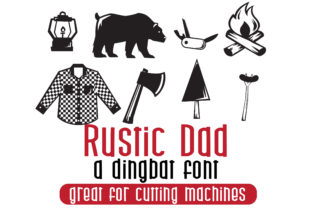
Rustic Dad is a hand-drawn display font built around 26 original camping-themed illustrations—think vintage tent silhouettes, pine boughs, enamel mugs, compass roses, and weathered trail markers. Each glyph doubles as both letter and artifact: the “A” might double as an axe head; the “R” curls like a coiled rope. It’s not just typography—it’s tactile storytelling in type form.
Where Rustic Dad Fits Into Real Life (Not Just Design Mockups)
This isn’t a font you drop into a corporate annual report and call it a day. Rustic Dad thrives where authenticity matters more than polish—and where people are choosing *feeling* over function alone. Here’s where it shows up meaningfully:
- Small-Business Branding for Outdoor & Lifestyle Brands: A family-run gear shop in Colorado uses Rustic Dad on their reusable tote bags and workshop signage—not because it’s trendy, but because it mirrors their voice: grounded, experienced, quietly confident. Customers don’t just buy a carabiner; they buy into a shared language of trailside patience and gear that lasts longer than a season.
- Personalized Gifts That Land Differently: Think beyond “World’s Best Dad” mugs. A dad who taught his kids to identify constellations might get a framed star chart where the constellation names are set in Rustic Dad—each letter subtly echoing the shape of a camp lantern or folded map corner. The font adds narrative texture, turning a gift from sweet to deeply personal.
- Event Design With Emotional Anchors: Wedding couples hosting a forest glen ceremony use Rustic Dad for seating charts drawn on reclaimed wood slices and for menu cards tucked into mini canvas sacks. Guests don’t just read the entrée—they feel the intention behind the choice: unpretentious, rooted, unhurried.
- Educational & Community Materials: Nature centers, scout troops, and school outdoor ed programs use Rustic Dad in trail guides and safety posters. Why? Because kids respond differently to type that looks *made*, not generated. A “Watch for Bears” sign in Rustic Dad feels less like a rule and more like advice from someone who’s seen tracks firsthand.
Who Benefits—and How Their Needs Shape the Use
The beauty of Rustic Dad is how flexibly it serves different intentions—without bending its core identity.
For makers and crafters, it’s a shortcut to visual cohesion. If you laser-cut wooden coasters with hiking trail names, setting those names in Rustic Dad means your typography matches your materiality—no extra styling needed. You’re not designing *around* the font; you’re letting it reinforce what you already do well.
For marketers at local breweries or farm-to-table restaurants, Rustic Dad helps signal values before a single word is read. A seasonal IPA called “Pine Needle Trail” gains instant context when its label uses Rustic Dad—no need to explain “rustic” in the copy. The font does that work silently, respectfully.
For parents documenting milestones, it brings warmth to digital moments. A photo collage of a child’s first solo tent night, captioned in Rustic Dad over a faded flannel background, reads like a memory—not a post. It leans into imperfection (slight variations in stroke weight, intentional ink bleed effects) so the focus stays on the experience, not the execution.
What to Consider Before You Reach for Rustic Dad
Like any tool with strong personality, Rustic Dad shines brightest when matched thoughtfully to purpose—not just aesthetics.
Readability at small sizes is limited. It’s a display font, not a text face. You’ll want to reserve it for headlines, signs, packaging, or short phrases—not body copy, app interfaces, or legal disclaimers. That’s not a flaw—it’s by design. Trying to force it into tiny labels or dense paragraphs will dilute its impact and frustrate readers.
It carries tone—so match it to your audience’s expectations. A tech startup launching an AI-powered camping app might find Rustic Dad too literal, too analog. But that same app’s community newsletter? Perfect place for Rustic Dad in section headers—grounding the innovation in human experience.
Licensing matters—especially for commercial use. Rustic Dad is often sold with clear usage tiers: personal projects, small business branding, or extended licenses for product packaging or merchandise resale. If you’re printing it on 500 trail guidebooks or embedding it in a mobile app, check the license terms upfront. Skipping this step can turn a heartfelt gesture into a legal hiccup.
Strengths That Feel Like Common Sense
Rustic Dad earns trust fast—not through novelty, but through consistency with real-world cues. Its strength lies in what it doesn’t do: it doesn’t mimic handwriting so precisely that it feels performative; it doesn’t over-polish its edges until it loses soul. Instead, it balances looseness with intention—like a well-tied bowline knot: relaxed, reliable, and unmistakably human.
And because it includes those 26 camping images as integral glyphs—not as separate icons—you get visual unity without layering assets. The “C” in “Campfire” can literally be a curl of smoke. The “T” in “Trail” doubles as a topographic line. That kind of embedded meaning saves time, reduces visual clutter, and deepens resonance.
When Rustic Dad Might Not Be the Right Fit
It’s okay—and smart—to pass. Rustic Dad isn’t built for high-contrast accessibility needs out of the box (though thoughtful pairing with a clean sans-serif for supporting text solves this). It won’t suit brands leaning into urban minimalism, hyper-futurism, or clinical precision. And if your project hinges on global multilingual support (beyond basic Latin characters), verify glyph coverage early—some versions focus tightly on English-language camping vocabulary.
None of this limits its usefulness. It simply means Rustic Dad asks you to meet it halfway: to know your purpose, honor your audience’s expectations, and let the font amplify—not override—what you’re already doing well.
In a world saturated with frictionless, algorithm-optimized visuals, Rustic Dad stands apart by embracing the slight irregularities of human making—the smudge, the pause, the careful hand that drew each letter like it mattered. It’s not about going back to the woods. It’s about bringing the woods’ quiet confidence into what you make, share, and celebrate—every day.