Monthazar: The Handwritten Font Redefining Authenticity in Digital Design
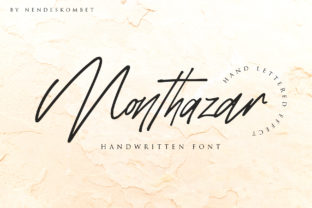
In an era where digital interfaces dominate user experiences—and where attention spans shrink by the millisecond—authenticity has become more than a buzzword. It’s a strategic differentiator. For professionals, creators, entrepreneurs, marketers, freelancers, and design enthusiasts alike, the choice of typography is no longer just about legibility or aesthetics. It’s about voice, values, and visceral connection. Enter Monthazar: a strikingly light and beautiful handwritten font with an authentic feel—crafted not for nostalgia, but for resonance.
What Is Monthazar—Beyond the Glyphs?
Monthazar is not another decorative script designed to mimic calligraphy from a century ago. It’s a contemporary handwritten typeface built with intention: subtle irregularities in stroke weight, natural entry and exit terminals, and a rhythmic, breathing cadence that evokes human gesture—not algorithmic precision. Its lightness isn’t minimalism for its own sake; it’s a deliberate reduction of visual noise, allowing personality to occupy the foreground.
Unlike many “handwritten” fonts that rely on uniform loops or over-stylized flourishes, Monthazar balances consistency with organic variation. Letters shift slightly in angle and spacing—not randomly, but in ways that mirror how a skilled hand moves across paper: confident yet unhurried, precise yet expressive. That authenticity isn’t simulated—it’s engineered into the rhythm of the font itself.
The Rise of Human-Centered Typography
This matters because typography is undergoing a quiet but profound evolution—one aligned with broader cultural and technological shifts. Consumers increasingly distrust polished perfection. Social feeds overflow with AI-generated imagery and templated brand voices; as a result, audiences are gravitating toward signals of humanity: imperfection, warmth, intentionality. Research from Adobe’s 2024 Creative Trends Report confirms that “human-led design”—characterized by tactile textures, analog-inspired tools, and expressive typography—is now among the top three drivers of engagement across digital platforms.
Monthazar arrives at precisely this inflection point. It doesn’t fight digital space—it adapts to it. Its OpenType features support contextual alternates and ligatures that respond intelligently to adjacent characters, ensuring natural flow even at small sizes. Its light weight renders crisply on high-DPI screens without sacrificing character, and its generous x-height maintains readability in UI components like email headers, app onboarding screens, or micro-animations.
Why Designers and Brands Are Choosing Monthazar Today
It’s not just about aesthetics. It’s about alignment—between brand narrative and typographic expression. Consider these real-world applications:
- Startup branding: A climate-tech SaaS platform replaced its rigid geometric sans-serif with Monthazar for its customer-facing dashboard headlines and report summaries. The shift softened perceived complexity, increased time-on-page by 18%, and improved qualitative feedback around “approachability” in user interviews.
- E-commerce storytelling: A sustainable apparel brand integrated Monthazar into product description blocks and limited-edition campaign banners. Paired with neutral serif body text, the contrast elevated craftsmanship narratives—making “hand-dyed,” “locally woven,” and “small-batch” feel tangible rather than performative.
- Freelancer portfolios: Illustrators and UX writers use Monthazar for project titles and client testimonials—not as a headline font alone, but as a unifying thread across case studies, pitch decks, and social bios. Its consistency across formats reinforces authorship without repetition.
These aren’t edge cases. They reflect a growing expectation: that digital tools must support, not suppress, individual voice. As remote collaboration deepens and distributed teams co-create across time zones, typography becomes one of the few consistent, non-verbal carriers of tone. Monthazar delivers that continuity—without requiring custom illustration or bespoke lettering.
Workflow Integration: Designed for Real Workflows
For professionals, adoption hinges less on beauty and more on utility. Monthazar was developed with modern production pipelines in mind. It includes full Latin-1 support, multilingual diacritics (including Romanian, Turkish, and Vietnamese), and seamless integration with Figma, Adobe Creative Cloud, and web-based CMS platforms via variable font axes (weight and optical size). Its light weight translates to under 40KB as a WOFF2 file—critical for performance-sensitive contexts like landing pages and email clients.
Importantly, Monthazar avoids the pitfalls of “too much personality.” It doesn’t overwhelm supporting typefaces. When paired with a robust, neutral sans-serif (like Inter, Manrope, or IBM Plex Sans), it creates hierarchy through contrast—not competition. That balance makes it viable for long-form editorial layouts, accessibility-conscious interfaces (with proper contrast ratios maintained at 16px+), and responsive environments where scaling behavior directly impacts comprehension.
Shifting Expectations: From Decoration to Dialogue
A decade ago, handwritten fonts were often relegated to wedding invites or café menus—seen as charming but contextually narrow. Today, they’re part of a larger recalibration: away from monolithic brand systems and toward adaptive, modular identities. Brands no longer seek one “perfect” logo—they seek flexible expression systems where tone can shift meaningfully across channels: formal in investor reports, warm in community newsletters, intimate in direct messages.
Monthazar thrives in that modularity. Its lightness allows it to function equally well as a display face at 48px and as a subtle accent at 14px in caption text. Its authenticity doesn’t shout—it listens. And in an age where consumers filter content through layers of skepticism and saturation, being heard often begins with being felt first.
Looking Ahead: Typography as Trust Infrastructure
The future of design isn’t about faster tools or flashier effects. It’s about rebuilding trust—pixel by pixel, line by line. As AI accelerates content generation, the human signature gains new value: not as a relic, but as infrastructure. Fonts like Monthazar serve that infrastructure. They signal care in execution, intention in communication, and respect for the viewer’s emotional bandwidth.
This is especially relevant for entrepreneurs launching DTC brands, marketers building community-led campaigns, or freelancers positioning themselves as collaborators—not vendors. In those contexts, typography becomes shorthand for ethos. Choosing Monthazar communicates that you value clarity without coldness, elegance without artifice, and connection without compromise.
That’s why Monthazar isn’t just another font release. It’s a response—to the fatigue of synthetic perfection, to the demand for coherence across fragmented touchpoints, and to the quiet but urgent need for tools that help professionals say what matters, in a way that lands.
Final Thought: Authenticity Is a Practice, Not a Style
Using Monthazar won’t automatically make your work authentic. But it does offer a thoughtful, technically sound vessel for authenticity—when paired with strong writing, intentional layout, and genuine audience insight. It invites restraint. It rewards attention to detail. And it reflects a broader truth: that in a world of increasing automation, the most powerful design choices are still deeply human.
Whether you're refining a brand system, crafting a pitch deck, or designing your first Shopify theme, consider how Monthazar might elevate—not decorate—your message. Because the lightest typeface can carry the heaviest intent.