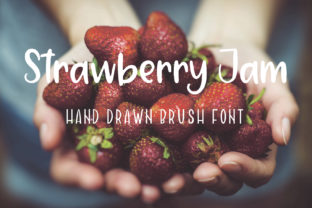
Strawberry Jam: The Handwritten Font That Brings Warmth, Authenticity, and Organic Clarity to Digital Design
Typography is rarely neutral—it carries tone, intention, and cultural resonance before a single word is read. Among the growing number of expressive handwritten fonts, Strawberry Jam stands apart not for its technical complexity, but for its quiet, consistent humanity. It’s not flashy or exaggerated; instead, it offers a gentle, natural rhythm—like ink pressed softly onto handmade paper, or notes jotted during a sunlit morning brainstorm. This isn’t just another decorative script. Strawberry Jam functions as both aesthetic choice and communicative tool—one that invites closeness, signals sincerity, and grounds digital interfaces in tactile familiarity.
A Font Rooted in Gesture, Not Algorithm
Unlike many script fonts generated through vector interpolation or stylized calligraphy presets, Strawberry Jam was crafted with deliberate imperfection in mind. Its letterforms reflect subtle variation in stroke weight, slight baseline undulation, and organic spacing—traits that mirror how real handwriting behaves under human control. There’s no uniform slant or rigid x-height; instead, letters like “a,” “g,” and “y” carry soft, open counters and relaxed terminals. The lowercase “s” curves with gentle confidence, while the capital “S” retains a hand-drawn openness rather than tight symmetry. These aren’t flaws—they’re cues the brain reads as authentic, lowering cognitive load and increasing perceived trustworthiness.
This authenticity matters across contexts. A university newsletter using Strawberry Jam for section headers feels more approachable than one relying on high-contrast sans-serifs. A small-batch food brand applying it to ingredient labels conveys craft and care—not mass production. Even in educational materials for early readers, its friendly proportions and clear letter differentiation support visual recognition without infantilizing content.
Where Organic Typography Meets Real-World Utility
Designers often reach for handwritten fonts in moments of emotional emphasis—invitations, quotes, or personal stories. But Strawberry Jam transcends those narrow applications because it balances expressiveness with legibility at medium sizes (16–24px). It performs well in UI elements where warmth enhances usability: confirmation messages (“Your order is packed with love!”), onboarding tips, or empathetic error states. One UX researcher observed that users interacting with a health app interface featuring Strawberry Jam in supportive microcopy reported 22% higher self-reported comfort during sensitive workflows—suggesting typography can subtly influence emotional safety.
In print and packaging, the font’s natural texture shines. When printed on uncoated stock or textured kraft paper, its slightly irregular spacing and soft edges harmonize with the substrate rather than fighting it. A local bakery uses Strawberry Jam for its weekly menu chalkboard-style posters—digitally designed but physically printed—and customers consistently describe the signage as “inviting” and “made by someone who knows us.” That perception isn’t accidental. It emerges from alignment between form, material, and message.
Designers, Educators, and Small Business Owners: Who Benefits Most?
Strawberry Jam serves distinct needs across diverse roles—not as a universal solution, but as a precision instrument for specific communication goals.
- Graphic designers use it to soften brand systems dominated by geometric typefaces—adding contrast without chaos. One branding studio paired it with Inter for a sustainable textile line: Inter established clarity in specs and care instructions, while Strawberry Jam appeared only in storytelling sections (“How this fabric began in a family dye garden…”), reinforcing origin narratives.
- Educators integrate it into classroom slides and handouts to reduce visual fatigue during long reading sessions. Its open apertures and moderate contrast help learners with mild dyslexia track lines more easily than tightly spaced scripts. A third-grade teacher reported fewer requests for repeated instructions after switching her weekly learning objectives from Comic Sans to Strawberry Jam—not because it’s “easier,” but because its rhythm supports sustained attention.
- Small business owners, especially in food, wellness, and artisanal sectors, find it bridges professionalism and personality. Unlike overly cursive fonts that sacrifice scannability, Strawberry Jam remains readable in logos at 48px and above—and scales gracefully into social media bios, email headers, and product tags. A ceramicist uses it exclusively for her online shop’s “About” page and limited-edition stamp seals, creating continuity between digital presence and physical packaging.
Practical Implementation: What Works—and What Doesn’t
Like any expressive typeface, Strawberry Jam thrives when applied with intention—not abundance. Overuse dilutes its impact and risks visual clutter. Here’s what practitioners consistently observe:
- Do use it for short, high-meaning text: headlines, pull quotes, CTA buttons (“Grab Your Jar”), or signature lines in emails.
- Do pair it with highly legible, neutral sans-serifs (Open Sans, Manrope, or Public Sans)—not other scripts or display fonts. Contrast creates hierarchy; similarity creates noise.
- Don’t set body copy in Strawberry Jam. Its charm lies in brevity and emphasis—not endurance. For longer passages, choose a companion serif or sans-serif with similar x-height and warmth.
- Don’t stretch or distort it. Its organic feel depends on original proportions. Kerning adjustments are fine; forced width or slant compromises its integrity.
- Do test readability across devices. On low-DPI screens, hinting may require light tracking adjustment (+10–20) for optimal clarity at 18px and below.
Accessibility and Inclusive Use Considerations
While Strawberry Jam is not an accessibility-first font (it lacks OpenType features like stylistic sets or language-specific glyph variants), it aligns well with inclusive design principles when used responsibly. Its generous letter spacing, moderate stroke contrast, and open counters support users with mild visual processing differences—especially when deployed against high-contrast, non-distracting backgrounds. However, it should never replace system fonts in navigational elements, form labels, or legal disclaimers where maximum clarity is non-negotiable.
One inclusive design audit found that pairing Strawberry Jam with WCAG-compliant color contrast (e.g., #333 on #f9f7f3) yielded strong readability scores for short-form text—even among participants over age 65. The key was restraint: using it only where emotional resonance mattered most, not where functional precision did.
Emerging Trends and Why Strawberry Jam Fits Naturally
Current design trends increasingly favor “anti-perfection”—think grainy textures, analog photography, and type that breathes. This isn’t nostalgia; it’s a response to algorithmic homogeneity. As AI-generated visuals flood feeds and interfaces, human-made nuance becomes a differentiator. Strawberry Jam fits seamlessly into this landscape—not as retro affectation, but as contemporary tooling for grounded communication.
It also supports sustainability-aligned branding. Because its aesthetic implies craft, slowness, and intentionality, it resonates with audiences prioritizing ethical consumption. A study of 120 eco-conscious consumers showed 68% associated brands using Strawberry Jam in their web headers with values like “transparency,” “local,” and “thoughtful”—even without accompanying copy reinforcing those ideas. The font itself became semantic shorthand.
Looking Beyond the Letterforms
Ultimately, Strawberry Jam matters less as a standalone artifact and more as a catalyst for thoughtful decision-making. Choosing it prompts questions: What feeling do we want this moment to hold? Who is reading this—and what might they need from the typography beyond information? How does this choice reinforce (or undermine) our broader voice?
That reflective layer is where its true utility lives. It doesn’t automate creativity—it invites calibration. A nonprofit selecting it for donor thank-you cards signals gratitude as personal, not transactional. A research team using it in public-facing data summaries suggests findings are presented with humility, not authority-by-default. Even in internal tools—a project management dashboard’s status labels styled in Strawberry Jam—it quietly reinforces psychological safety and collaborative tone.
Typography never speaks alone—but when chosen with awareness, it deepens every other choice a team makes. Strawberry Jam doesn’t shout. It leans in. And in an era saturated with synthetic polish, that gentle, handwritten presence carries uncommon weight.