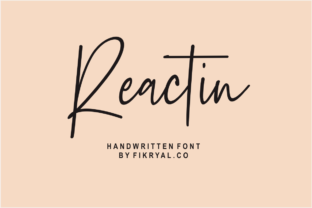
Reactin: A Handwritten Font for Authentic Design Projects
Reactin is a handwritten font designed to convey warmth, individuality, and modern authenticity. It features natural stroke variation, subtle irregularities, and expressive letterforms that mimic the rhythm of pen-on-paper writing—without appearing overly casual or childish. Unlike script fonts that prioritize flourish over function, Reactin balances personality with legibility, making it suitable for contexts where human tone matters but clarity remains essential.
Designers, marketers, and content creators often seek typefaces that reinforce brand voice without sacrificing readability. Reactin appeals to those evaluating fonts for projects where emotional resonance matters—such as personal branding, lifestyle blogs, artisan product packaging, or boutique web experiences. Its appeal lies not in novelty alone, but in how effectively it supports intent: communicating approachability, craftsmanship, or thoughtful curation.
Why Consider Reactin?
Several practical factors make Reactin worth evaluating during font selection:
- Distinctive yet restrained character: It avoids extreme embellishment, so it scales well across sizes—from small captions to large hero headings—without losing coherence.
- Consistent rhythm and spacing: Letterfit and kerning are carefully tuned, reducing the need for manual adjustments in most layout applications.
- Cross-platform compatibility: Available in standard OpenType format, Reactin works reliably in design tools like Figma, Adobe Creative Cloud, and web environments using @font-face or variable font embedding (where supported).
- Web performance considerations: As a single-weight, single-style font, its file size is modest—typically under 100 KB—making it lighter than multi-weight script families.
These traits support efficiency in implementation and consistency in output—key concerns when selecting any display or accent font for professional use.
Benefits and Realistic Expectations
Using Reactin can strengthen visual storytelling by reinforcing tone at a glance. In a crowded digital landscape, typography contributes significantly to first impressions; Reactin helps signal sincerity or care in contexts where users value human connection—such as wellness platforms, creative portfolios, or handmade goods sites.
However, expectations should align with its intended role. Reactin is best suited as a display or accent font—not for body text. Its handwritten nature limits extended reading comfort, especially at smaller sizes or on low-resolution screens. Users should anticipate pairing it with a neutral, highly legible sans-serif or serif for paragraphs and interface elements.
Also, while Reactin offers stylistic authenticity, it does not include extensive language support beyond Latin-based scripts (e.g., no Cyrillic, Greek, or extended diacritics). Projects requiring multilingual coverage may need supplemental fonts or fallback strategies.
When Reactin Is a Strong Fit
Reactin performs well in scenarios where hierarchy, mood, and differentiation are priorities:
- Branding for small businesses—particularly service-based or creative ventures where personality drives trust (e.g., freelance designers, yoga studios, independent publishers).
- Marketing assets with short copy—such as social media graphics, email headers, or product labels where concise messaging benefits from expressive typography.
- Web design accents—used sparingly for section titles, callouts, or quote blocks to add texture without overwhelming layout structure.
- Print collateral emphasizing craft—like invitation suites, zines, or limited-run posters where tactile qualities enhance perceived value.
In these cases, Reactin’s strength lies in its ability to complement—not compete with—other design elements. Its effectiveness increases when integrated intentionally, not applied generically.
When Alternatives May Be More Appropriate
Reactin is not universally optimal. Consider alternatives if your project involves:
- Long-form editorial content: For blogs, documentation, or news sites, readability over time outweighs stylistic flair. Fonts like Inter, Source Serif Pro, or IBM Plex Serif offer better paragraph performance.
- Strict accessibility requirements: While Reactin meets basic contrast standards, its variable stroke width and connected forms may reduce legibility for some users with visual impairments. More uniform, high-contrast fonts often provide stronger WCAG compliance out of the box.
- Corporate or technical branding: Industries emphasizing precision, authority, or neutrality (e.g., finance, legal, enterprise SaaS) typically benefit from more structured type systems. Reactin’s informality may unintentionally undercut desired perceptions of reliability.
- Dynamic or data-driven interfaces: Where text changes frequently (e.g., dashboards, real-time notifications), consistent rendering and predictable metrics matter more than expressive variation. Monospaced or geometric sans-serifs tend to integrate more smoothly.
Choosing a font isn’t about finding the “best” option—it’s about matching typographic behavior to functional and communicative needs.
Making an Informed Decision
Evaluating Reactin—or any handwritten font—requires testing in context. Before committing, ask:
- What is the primary message? If warmth and individuality support that message, Reactin may reinforce it. If clarity, speed, or formality dominate, reconsider.
- Where will the font appear? Test Reactin at actual usage sizes and weights across target devices. Does it remain legible in UI components? Does it render consistently in browsers you support?
- How much customization is needed? Some handwritten fonts require manual kerning or ligature management. Reactin minimizes this need, but previewing full character sets (including punctuation and numerals) reveals potential inconsistencies.
- What is the licensing scope? Confirm whether your intended use—web, desktop, app, or merchandise—falls within the license terms. Commercial projects often require extended licenses for redistribution or embedded use.
Finally, compare Reactin against other contemporary handwritten options—not just visually, but functionally. Look at x-height consistency, italic availability, OpenType features (like stylistic alternates), and documentation quality. These details affect long-term maintainability and scalability.
Reactin stands out for designers seeking authenticity without sacrificing usability. It reflects current preferences for human-centered design—but only when matched thoughtfully to purpose, audience, and medium. Like any tool, its value emerges not from its features alone, but from how deliberately it’s applied.