Hop and Pop: Whimsy with Precision
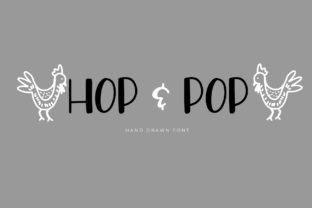
If you’ve ever seen a font that makes you smile before you even read the words—like a wink in type form—you’ve felt the quiet magic of Hop and Pop. It’s not just another script font. It’s a carefully balanced paradox: playful but polished, spontaneous but intentional, hand-drawn in spirit yet engineered for real-world use. Designed as a premium font, Hop and Pop sits comfortably in the script font category—but it avoids the pitfalls of many handwritten fonts: no awkward joins, no inconsistent spacing, no “too-cute” instability that undermines legibility at scale.
A Typeface That Breathes Like a Person
At first glance, Hop and Pop feels like ink sketched by someone who knows exactly when to lift the pen—and when to let a loop linger. Its letters hop (literally—the ‘o’s bounce, the ‘p’ pops upward with gentle tension) and its rhythm is light, never frantic. The stroke contrast is subtle, not dramatic; there’s no heavy slab-serif weight or aggressive calligraphic flair. Instead, it uses soft terminals, open counters, and generous x-heights to stay friendly at small sizes and expressive at large ones. You’ll notice how the lowercase ‘g’ has a graceful, closed tail—not the floppy double-storey version that can blur in digital thumbnails—and how the uppercase ‘S’ curves with confident asymmetry, not rigid symmetry.
This isn’t a font that shouts. It murmurs charm. That makes it unusually versatile: equally at home on a boutique candle label as it is in an editorial pull quote for a mindful living blog. Unlike many modern script fonts that lean hard into nostalgia or retro kitsch, Hop and Pop feels contemporary—clean enough for a tech startup’s event banner, warm enough for a children’s book illustrator’s website headline.
Where Hop and Pop Earns Its Keep
Think of Hop and Pop as your go-to display font—not for body text, but for moments where tone matters more than volume. It excels where personality needs to land quickly and authentically: logo design for lifestyle brands, packaging design for artisanal food or skincare, social media graphics for wellness coaches or indie stationery shops, and editorial design for newsletters or zines focused on creativity, self-expression, or slow living.
In web design, it works best as a hero-font pairing—used sparingly for headlines, buttons, or section dividers—paired with a neutral sans serif (think Inter, Poppins, or Manrope) for body copy. Its letterforms hold up well on screens down to ~24px, especially with proper tracking adjustments and sufficient line height. In print? It shines in letterpress invitations, foil-stamped business cards, and illustrated book covers—where its texture gains dimension without sacrificing clarity.
What sets it apart from generic script fonts is how it supports brand identity without overselling. A bakery using Hop and Pop doesn’t scream “cute”—it signals care, craft, and approachability. A podcast about creative entrepreneurship using it in its intro animation doesn’t feel frivolous; it feels human, grounded, and intentionally warm.
Testing Fit Before Committing
Before licensing Hop and Pop, ask three practical questions: What emotion do I want this word—or phrase—to carry? Will it appear where users scan, not study? Does it need to coexist with other typefaces without clashing?
Run a quick test: set your core headline in Hop and Pop at 36–48px, then step back. Does it feel inviting—or does it distract? Try setting the same phrase in a tight paragraph with a clean sans serif beside it. Does the contrast elevate both—or does one overpower the other? Hop and Pop includes standard OpenType features like ligatures and alternate characters, but most users won’t need them unless designing high-end packaging or custom illustrations. Its real strength lies in simplicity: one weight (regular), one style (upright), no italics or bold variants. That’s intentional—it’s meant to be used *as is*, not stretched across a typographic system.
Readability isn’t compromised, but it’s contextual. At 14px in UI labels? Not ideal. As a 60px Instagram Story headline over a muted background? Excellent. Always test in your actual medium—not just in a font previewer. On mobile, check how it renders in Safari vs. Chrome. On packaging, mock it up at actual size with your substrate (kraft paper dulls contrast; glossy stock enhances it).
Pairing Without Overthinking
Forget “perfect” pairings—aim for respectful contrast. Hop and Pop thrives next to typefaces with clear geometry and open apertures. Try it with a friendly geometric sans like Montserrat or a warm neo-grotesque like Nunito. Avoid overly decorative serifs or tightly spaced monospaced fonts—they compete for attention. For editorial layouts, try pairing it with a modest serif like Lora or Cormorant Garamond for subheads, then a crisp sans for captions. The goal isn’t harmony at all costs—it’s hierarchy with heart.
You’ll also want to review the included file formats (OTF, WOFF2, etc.) and ensure they match your workflow. Designers using Figma or Adobe apps will appreciate the native OTF support. Developers embedding it in a Shopify theme should confirm WOFF2 compatibility and load performance—Hop and Pop is lightweight (<150KB), so it won’t drag down page speed.
Licensing That Matches Real Work
Hop and Pop is a commercial font, meaning it requires a license for any project intended for public use or profit—even if you’re a solo blogger monetizing via affiliates or a crafter selling printable art on Etsy. The standard license covers websites (up to a traffic threshold), digital ads, social graphics, and unlimited print runs for physical products you sell. If you’re building templates for resale (e.g., Canva templates or Notion themes), you’ll need an extended license—check the foundry’s terms directly, not third-party marketplaces.
No hidden fees, no subscription. One-time purchase, perpetual use—provided you comply with redistribution limits. That predictability matters when you’re budgeting for design assets across multiple client projects or launching your own product line.
Ultimately, Hop and Pop works because it doesn’t try to be everything. It’s not a workhorse text font. It’s not a futuristic tech face. It’s a moment of levity, precision, and warmth—delivered in letters. When used with intention, it doesn’t just decorate a page. It extends an invitation.