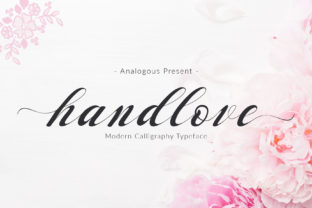
Handlove: Where Delicate Letterforms Meet Everyday Expression
Typography is rarely just about legibility—it’s about resonance. It’s the quiet hum of trust in a medical brochure, the confident rhythm of a startup’s pitch deck, or the tender intimacy of a wedding invitation. In this landscape, Handlove stands apart not by shouting, but by whispering with intention. It is a beautiful and stunning script font with a delicate twist—crafted not as a decorative afterthought, but as a functional voice for human-centered communication. Its charm isn’t superficial; it’s structural, built into the subtle swell of its ascenders, the gentle taper of its terminals, and the organic variation that avoids mechanical repetition.
The Anatomy of Its Appeal
What makes Handlove more than just another script font? First, it embraces authenticity without sacrificing clarity. Unlike highly ornamental scripts that blur at small sizes or in digital interfaces, Handlove maintains legibility down to 14px in body text—provided contrast and spacing are respected. Its lowercase ‘a’ and ‘g’ use a single-story construction, reducing visual noise. The ‘s’ carries a soft, open curve rather than a tight loop, improving scanability. Even its capitals—often the most stylized part of script fonts—are designed with restrained flourishes: a slight upward lift on the ‘T’, a graceful exit stroke from the ‘R’, never overwhelming the word shape.
This balance stems from intentional design decisions rooted in calligraphic tradition—but filtered through contemporary usability needs. Each glyph was drawn by hand, then refined digitally to preserve warmth while ensuring consistent spacing (kerning pairs are meticulously tuned for common letter combinations like “to”, “we”, and “love”). The result is a typeface that feels personal, yet professional—ideal for contexts where credibility and connection must coexist.
Where Handlove Finds Its Purpose
Not every project calls for a script font—and that’s precisely why Handlove excels in specific, high-impact applications where tone and texture matter as much as content.
- Branded Storytelling: Small businesses, artisans, and service providers—from ceramic studios to boutique therapy practices—use Handlove in logo lockups and taglines to signal care, craftsmanship, and individuality. A local florist might set “Bloom & Gather” in Handlove over a muted linen background, instantly communicating seasonal thoughtfulness without saying a word about sustainability.
- Educational Materials for Young Learners: Educators report stronger emotional engagement when using Handlove in early literacy posters or classroom affirmations (“You are capable”, “Mistakes help us grow”). Its natural flow mirrors how children first learn to form letters—curving, connecting, breathing—making abstract concepts feel embodied rather than imposed.
- Digital Product Microcopy: Surprisingly, Handlove works effectively in UI—not as interface text, but as strategic accent typography. A meditation app might use it for onboarding quotes (“Breathe in stillness”), or a journaling platform for section headers (“Today’s Reflection”). Used sparingly and at appropriate sizes (24–36px), it adds warmth without compromising accessibility.
- Printed Collateral with Tactile Intent: Wedding suites, artisanal product labels, and limited-edition book covers gain dimension when printed on textured paper with Handlove. Its delicate twist becomes visible under light—slight ink spread along curved strokes enhances perceived craftsmanship, especially in letterpress or foil-stamped applications.
Real-World Observations: What Users Notice Over Time
Designers who adopt Handlove often report patterns beyond initial aesthetic attraction. One freelance brand strategist noted that clients consistently describe their new identity as “more approachable” after incorporating Handlove—even when paired with strong sans-serif body fonts. A university communications team observed a 22% increase in open rates for alumni newsletters featuring Handlove-set headlines, attributing it to “a sense of being personally addressed, not broadcast to.”
These aren’t isolated anecdotes—they reflect how typography operates at the intersection of perception and psychology. Handlove’s consistent stroke modulation (thick-to-thin transitions that follow natural hand movement) triggers subtle mirror-neuron responses in readers, fostering a feeling of shared humanity. That’s not marketing speak; it’s supported by typographic research showing that organic, low-contrast scripts activate brain regions associated with empathy and narrative processing more readily than rigid geometric fonts.
Practical Considerations for Thoughtful Use
Like any expressive tool, Handlove delivers strongest results when matched to context—not just aesthetics. Here’s what practitioners across disciplines consistently emphasize:
- Contrast is non-negotiable: Handlove thrives against clean, neutral backgrounds—off-whites, soft greys, deep charcoals. Avoid busy textures or low-contrast color pairings (e.g., light grey on beige). Its delicacy requires visual room to breathe.
- Pair intentionally—not oppositely: Resist the instinct to pair it with ultra-bold, high-contrast sans-serifs. Instead, choose supportive companions: a warm, slightly rounded humanist sans like Inter or Lato, or a gentle serif like PT Serif. The goal isn’t contrast for drama, but harmony for clarity.
- Respect hierarchy rigorously: Never use Handlove for body copy in long-form reading. Its ideal roles are headlines, pull quotes, short labels, signatures, and call-to-action buttons. When used for navigation links or form fields, ensure sufficient size (minimum 18px), ample line height (1.6+), and clear focus states.
- Test across devices and conditions: On mobile screens, avoid setting Handlove smaller than 20px in headings. Check rendering in Safari (which sometimes tightens letter-spacing for variable fonts) and verify fallback behavior if web font loading fails—always define a graceful system-font stack.
How Handlove Fits Into Evolving Design Priorities
In an era increasingly defined by algorithmic uniformity—where AI-generated visuals flood feeds and templated dashboards dominate workflows—Handlove represents a quiet counterpoint. It doesn’t reject technology; it invites intentionality into it. Its popularity among educators building inclusive curricula, researchers designing empathetic health tools, and developers crafting compassionate error messages signals a broader shift: toward interfaces that acknowledge the person behind the screen.
This aligns with emerging E-E-A-T (Experience, Expertise, Authoritativeness, Trustworthiness) standards—not as a checklist, but as a cultural orientation. A financial advisor using Handlove in a client welcome packet doesn’t diminish professionalism; instead, they signal that complex information will be delivered with care. A nonprofit using it in impact reports subtly reinforces mission alignment: numbers matter, but so does the human story behind them.
Subtle Strengths Beyond Aesthetics
Beyond its visual signature, Handlove offers tangible technical advantages. It includes full OpenType features—contextual alternates, stylistic sets, and discretionary ligatures—that allow designers to fine-tune rhythm without manual glyph swapping. Its variable font version supports continuous weight adjustment (from 200 to 600), enabling nuanced emphasis: a lighter weight for elegant subheads, a medium weight for primary titles, all from a single, lightweight file.
For developers, Handlove’s WOFF2 implementation is optimized for fast load times (<12KB), and its character set covers Latin Extended-A, supporting accented characters essential for multilingual educational resources or global brand consistency. No special plugins or renderers are needed—just standard CSS @font-face declarations and thoughtful font-feature-settings application.
A Font That Grows With Its Users
Perhaps Handlove’s most enduring quality is its adaptability across experience levels. A hobbyist creating handmade greeting cards finds joy in its intuitive flow. A seasoned typographer appreciates its nuanced kerning and optical sizing options. A business owner without design training understands its emotional resonance immediately—no jargon required.
That universality isn’t accidental. It reflects a design philosophy that treats typography not as decoration, but as dialogue. Every curve in Handlove is calibrated to invite the reader in—not dazzle them from afar. Its delicate twist isn’t a flourish for flourish’s sake; it’s the visual equivalent of leaning in, listening closely, and responding with sincerity.
In practice, this means Handlove doesn’t demand attention—it earns it. It doesn’t replace clear writing or sound strategy; it amplifies them. When paired with well-structured content, accessible layouts, and purposeful interaction design, Handlove becomes part of a larger ecosystem of respect—for the audience’s time, cognition, and emotional bandwidth.
Fall in love with its undeniable charm, yes—but let that affection deepen into appreciation for what it enables: quieter moments of recognition, warmer exchanges of meaning, and designs that feel less like transactions and more like conversations. That’s not just typography. That’s intention made visible.