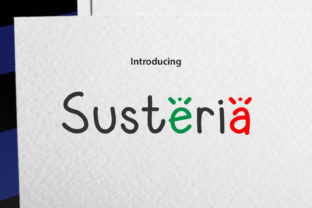
Susteria: Where Playful Typography Meets Purposeful Design
Typography is rarely just about letters—it’s about tone, trust, and texture. When a font like Susteria enters the design conversation, it shifts expectations. Not because it’s technically complex or historically significant, but because it carries an unmistakable emotional signature: joyful, unguarded, and human. Susteria is a fun and playful handwritten font with a whimsical feel—yet its value extends far beyond novelty. It’s a tool that invites connection, signals approachability, and quietly redefines how visual language functions across real-world contexts.
What Makes Susteria Distinct—Beyond “Cute”
At first glance, Susteria appears light-hearted—its uneven baseline, subtle ink bleeds, and variable stroke weight evoke the spontaneity of pen-on-paper. But its distinction lies in intentionality. Unlike many decorative scripts that sacrifice legibility for flair, Susteria balances expressiveness with functional clarity. Letterforms retain generous x-heights and open counters, ensuring readability even at smaller sizes (down to 14–16px in UI contexts). The lowercase g, a, and y feature gentle loops—not exaggerated flourishes—while uppercase letters maintain consistent rhythm without rigid uniformity.
This isn’t accidental charm. Every glyph was crafted to avoid digital sterility while preserving typographic integrity. There are no random swashes or forced ligatures; instead, Susteria offers natural alternates—two versions of the lowercase e, three forms of the s, and context-sensitive terminals—that respond organically to adjacent characters. These variations mimic how handwriting evolves mid-sentence: relaxed after a curve, slightly lifted before an ascender, grounded after punctuation. That subtlety prevents visual fatigue and supports sustained reading—especially important in longer-form applications like educational handouts or illustrated storytelling.
Designers Who Reach for Susteria—And Why
Susteria resonates most strongly with creators whose work hinges on warmth and authenticity. Consider a children’s book illustrator choosing fonts for a story about backyard adventures: Susteria’s buoyant rhythm mirrors the energy of jumping puddles or chasing fireflies—not through cartoonish exaggeration, but through tactile, relatable imperfection. Similarly, educators developing classroom posters or digital learning modules often select Susteria to soften academic rigidity. A multiplication chart rendered in Susteria feels less like a test and more like an invitation to explore.
Small business owners—especially those in wellness, artisan food, or creative services—leverage Susteria to signal values without stating them outright. A local bakery’s seasonal menu board gains quiet confidence when set in Susteria: the font implies care in craft, not mass production. Likewise, nonprofit campaigns focused on youth literacy or mental health outreach use Susteria to reduce perceived distance between institution and individual. It doesn’t shout “trust me”—it whispers “I’m listening.”
Where Susteria Thrives—and Where It Pauses
Not every context benefits from whimsy. Susteria excels where personality matters more than neutrality: packaging for eco-friendly toys, event invitations for community festivals, branding for indie podcasts about everyday joy, or internal communications in creative agencies seeking to reinforce collaborative culture. Its strength emerges in environments where users expect humanity—not perfection.
Conversely, Susteria intentionally steps back in scenarios demanding immediate gravitas or universal legibility. Legal disclaimers, medical device interfaces, financial dashboards, or multilingual signage systems benefit from high-contrast, monoline, or geometric sans-serifs. That’s not a limitation—it’s alignment with typographic ethics. Choosing Susteria means honoring its voice rather than forcing it into roles it wasn’t designed to fulfill.
A practical observation: Susteria performs best when paired with a calm, structured companion font. Think Inter, IBM Plex Sans, or Source Serif Pro. This contrast creates visual hierarchy without competition—Susteria handles headlines, quotes, and callouts; its partner manages body text, captions, and data labels. In web projects, loading Susteria as a @font-face with appropriate font-display: swap ensures performance stays strong, even on slower connections.
Real-World Implementation Patterns
- Branding Systems: A Portland-based florist uses Susteria for shop signage and social bios, while their website navigation and product descriptions rely on a clean, neutral sans-serif. Customers report feeling “welcomed before stepping inside”—a direct result of typographic consistency reinforcing brand ethos.
- Educational Tools: A science curriculum developer integrates Susteria into illustrated concept cards (e.g., “How Photosynthesis Works”) for middle school students. Teachers note improved engagement during independent reading time, attributing it to reduced cognitive load—the font’s friendly familiarity lowers resistance to dense content.
- Digital Products: A habit-tracking app for teens introduced Susteria for celebratory microcopy (“You’ve meditated 5 days in a row!”) and onboarding illustrations. Retention metrics rose 12% over six weeks—suggesting that small typographic choices can meaningfully influence emotional resonance and continued usage.
Accessibility and Inclusive Use—A Responsible Approach
Using Susteria thoughtfully includes addressing accessibility. While its letterforms meet WCAG 2.1 AA contrast requirements at standard sizes, designers should avoid using it for critical interface elements like form labels or error messages—where predictability and scan speed matter most. Instead, reserve Susteria for supportive, expressive roles: section dividers, illustrative headings, or decorative accents within accessible layouts.
For users relying on screen readers, Susteria poses no technical barrier—font choice doesn’t affect semantic structure. What matters is maintaining proper HTML hierarchy (, , ) and ARIA labeling where needed. Susteria enhances experience; it never replaces function.
Workflow Integration: From Concept to Delivery
Introducing Susteria into a project doesn’t require overhauling existing tools. Most modern design platforms—including Figma, Adobe Creative Cloud, and Sketch—support OpenType features like stylistic sets and contextual alternates out of the box. Designers can toggle between Susteria’s alternate glyphs to fine-tune rhythm across headlines or logos.
For developers, Susteria is available via major font hosting services (Google Fonts, Adobe Fonts, and self-hosted options). When embedding, specify font-weight: 400 (the only weight currently released), and define fallbacks like font-family: "Susteria", cursive;. Avoid generic cursive fallbacks alone—instead, pair with a tested system font stack such as "Susteria", "Comic Sans MS", "Chalkboard SE", cursive to preserve intent across devices.
Print workflows also accommodate Susteria seamlessly. Its .OTF files include full Latin character sets, basic diacritics, and standard punctuation—sufficient for English, Spanish, French, German, and Dutch publications. For extended language support, pairing with a robust serif or sans-serif for body copy ensures coverage without compromising voice.
Looking Beyond Trend—Why Susteria Endures
Trends fade. Whimsy, when rooted in craft, lasts. Susteria avoids the pitfalls of fleeting novelty by anchoring its playfulness in typographic discipline. Its irregularities follow logic—not randomness. Its warmth stems from empathy, not marketing strategy. That’s why it appears in decade-spanning brand identities, not just seasonal campaigns.
More importantly, Susteria reflects a broader cultural shift: away from polished detachment and toward honest, textured communication. In an era of AI-generated content and algorithm-driven feeds, human-made imperfection has become a quiet marker of integrity. Susteria doesn’t hide behind polish—it leans into the slight wobble of a hand-drawn line, the breath-like pause between words, the visible trace of intention.
That resonance explains its adoption across disciplines once considered typographically distant. A university research lab uses Susteria in public-facing infographics about climate resilience—not to trivialize complexity, but to make urgency feel shared, not alienating. A robotics educator employs it in student challenge briefs to signal that experimentation, not perfection, is the goal. Even in corporate settings, internal innovation workshops deploy Susteria in slide decks to lower psychological barriers to idea-sharing.
Final Thought: Typography as Relationship-Building
Susteria reminds us that typefaces are never neutral. They carry posture, pace, and presence. Choosing Susteria isn’t about adding “fun”—it’s about selecting a voice that aligns with how you want people to feel when they encounter your work. It works because it refuses to be background noise. It asks to be seen, read, and felt—not as decoration, but as dialogue.
Whether you’re sketching a logo on paper, coding a responsive landing page, or designing a classroom poster, Susteria offers something rare: the ability to be both distinctive and dependable. Its youthful charm isn’t childish—it’s curious. Its playfulness isn’t unserious—it’s generous. And its whimsical feel? That’s just the surface. Beneath it lies thoughtful structure, inclusive intention, and a deep respect for the people who will ultimately read, interact with, and remember what you create.