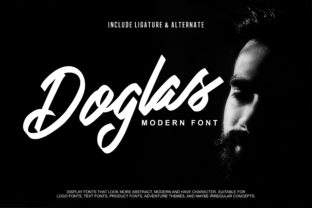
Doglas: A Modern Handwritten Font
Doglas is a carefully crafted handwritten font that balances organic flow with clean, contemporary structure. It’s not just “scripty”—it has rhythm, contrast, and subtle personality in every glyph. Letters connect naturally but never feel forced; spacing breathes without sacrificing impact. Designed for real-world use—not just display—it supports full Latin character sets, common diacritics, and OpenType features like stylistic alternates and ligatures.
Why Doglas Fits Different People—Differently
What makes Doglas valuable isn’t one universal trait—it’s how its qualities align with *your* goals, tools, and context. A teacher preparing classroom posters doesn’t need the same features as a freelance designer building a brand identity. Let’s look at how it lands across roles and intentions.
For Beginners Who Want Simplicity Without Sacrifice
If you’re new to typography—or just want something that works instantly—Doglas stands out for its plug-and-play clarity. You don’t need to master kerning or OpenType panels to get great results. Install it, type a headline in Canva or Google Slides, and it reads as warm, intentional, and professional. No learning curve. No confusion about which weight or style to pick—Doglas ships as a single, cohesive family with one weight and one style, designed to be expressive on its own.
Example: A local bakery owner updating their Instagram Stories can drop Doglas into a free design tool and instantly elevate a “Fresh Sourdough Today!” post—no designer hired, no tutorial watched.
For Designers and Brand Professionals Seeking Distinction
Experienced designers often juggle legibility, tone, and scalability. Doglas delivers a rare combination: hand-drawn authenticity *and* typographic reliability. Its letterforms hold up well at small sizes (like app icons or product tags), yet shine large (on signage or hero banners). Unlike many handwritten fonts that collapse into visual noise when scaled down, Doglas maintains readability thanks to deliberate stroke contrast and open counters.
It also avoids overused tropes—no exaggerated flourishes, no faux-calligraphic drama. That makes it especially useful for brands aiming for approachable sophistication: wellness studios, boutique publishers, indie fashion labels, or educational platforms wanting warmth without whimsy.
For Educators and Content Creators Prioritizing Clarity and Tone
In learning environments—whether a university slide deck or a YouTube explainer—the right font quietly reinforces trust and engagement. Doglas feels human and attentive, not robotic or cold. That matters when presenting complex ideas or guiding learners through step-by-step material. Its lowercase ‘a’, ‘g’, and ‘e’ are clear and unambiguous, reducing cognitive load—especially helpful for students with dyslexia or those viewing content on smaller screens.
One high school art teacher uses Doglas for rubric headers and project briefs. Students report feeling the instructions are “more inviting” and “less intimidating” than standard sans-serifs—without losing precision.
For Small Business Owners Weighing Value and Versatility
Time and budget matter. Doglas is licensed for both personal and commercial use—including websites, social media, printed menus, packaging, and merchandise—with no hidden tiers or usage caps. You won’t hit a wall mid-project wondering if your license covers email newsletters *and* a Shopify banner *and* a trade show backdrop. That predictability saves stress—and money—over time.
It also pairs effortlessly with neutral sans-serifs (like Inter, Lato, or even system fonts) for balanced hierarchy. A café owner might set their menu title in Doglas and body text in a clean sans-serif—creating instant visual distinction while keeping everything legible and printable.
For Hobbyists and Makers Who Care About Craft
If you sketch by hand, paint, or craft physical goods, Doglas resonates because it mirrors intention—not perfection. Its slight variation in stroke width and natural entry/exit angles echo how people actually write, not how machines render lines. That authenticity translates well to handmade aesthetics: wedding invitations, zine covers, pottery stamps, or embroidery pattern labels.
One ceramicist uses Doglas to label her online shop’s product cards—pairing it with soft photography and linen textures. Customers consistently comment that the typography “feels like part of the making process,” not an afterthought.
What to Consider Before Choosing Doglas
Doglas excels where warmth, clarity, and modern handwriting are needed—but it’s not meant for every job. Ask yourself:
- Is legibility at small sizes critical? Yes—it performs well down to ~14px in UI contexts, but avoid using it for dense paragraph text or legal disclaimers.
- Do you need multiple weights or widths? No—Doglas is intentionally focused. If your project demands bold, light, condensed, or italic variants, you’ll pair it with a complementary typeface instead.
- Are you working across languages? It supports Western and Central European languages well. For extended Cyrillic, Greek, or non-Latin scripts, check the character map before committing.
- Does your workflow rely on variable font tech? Doglas is static (not variable), so it won’t adapt weight or width via CSS. But it loads quickly and renders consistently across browsers and apps.
Real Projects, Real Results
A nonprofit launching a mental health awareness campaign used Doglas for all campaign headlines—paired with a restrained serif for body copy. The result? Higher engagement on Instagram carousels and stronger emotional resonance in printed brochures.
A freelance UX writer tested Doglas in a prototype for a meditation app. Users described onboarding screens as “calm but clear”—a direct contrast to the sterile feel of default system fonts.
A homeschool parent created printable weekly planners using Doglas for section headers and habit trackers. Her kids started using the planner more consistently—not because of the content, but because “the writing looks like it’s talking to me.”
These aren’t edge cases. They reflect how Doglas serves purpose—not just aesthetics.
Does Doglas Fit Your Next Project?
Try asking three simple questions:
- Does my project benefit from a human, thoughtful voice—not just visual flair?
- Will this font appear where tone and approachability matter as much as information?
- Do I value consistency, ease of use, and broad compatibility over endless stylistic options?
If two or more resonate, Doglas is likely a strong match. It won’t solve every typographic challenge—but where it fits, it elevates with quiet confidence.