Intensiva Family: A Humanistic Sans Serif Built for Clarity, Economy, and Creative Confidence
Typography is rarely just about letters—it’s about intention, efficiency, and the quiet authority of well-placed form. In a landscape increasingly shaped by constrained interfaces, rapid content iteration, and heightened visual literacy, typefaces must do more than look good. They must perform with precision, adapt without compromise, and communicate tone before a single word is read. Enter Intensiva Family: a humanistic sans serif designed in 2019 by Pablo Balcells for Graviton Font Foundry—not as a stylistic experiment, but as a pragmatic response to how professionals actually work today.
A Typeface Engineered for Real-World Demands
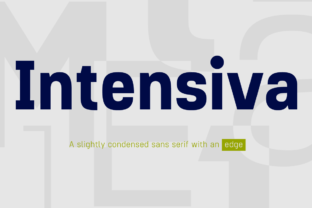
At first glance, Intensiva Family stands apart—not through eccentricity, but through considered restraint. It is slightly condensed, yes, but not at the expense of legibility. Its humanist foundations—evident in open apertures, gentle stroke modulation, and organic rhythm—anchor it in readability across sizes and contexts. What makes it distinctive are its angular details and shortened terminals: subtle interruptions in line continuity that lend visual energy without sacrificing neutrality. These aren’t decorative flourishes; they’re functional signatures—small deviations that improve character distinction at small sizes and reinforce typographic hierarchy at large ones.
This balance is intentional. Unlike ultra-narrow display fonts or monospaced system fonts, Intensiva Family operates across the full spectrum: from UI labels and dashboard metrics to long-form editorial layouts and brand guidelines. Its subtle condensation delivers measurable space economy—particularly valuable in responsive web design, mobile-first applications, and print materials where real estate is finite but clarity is non-negotiable.
Why Designers and Brands Are Turning to Intensiva Family Now
The rise of Intensiva Family reflects deeper shifts in professional practice—not trends, but tectonic adjustments in how creators operate. Consider three converging forces:
- Interface density is rising. With SaaS dashboards, analytics panels, and embedded widgets packing more functionality into tighter spaces, designers need type that conveys information quickly and accurately. Intensiva’s compact proportions and high x-height mean more content fits without scrolling or zooming—reducing cognitive load and supporting faster decision-making.
- Brand voice demands consistency across fragmented touchpoints. A startup’s landing page, investor deck, email campaign, and packaging must feel unified—not identical, but unmistakably connected. Intensiva Family’s range (with six weights and true italics) provides tonal flexibility while preserving structural coherence. A light weight sets calm, editorial tone; a bold weight commands attention in CTAs—without requiring a second typeface.
- Content velocity has outpaced production bandwidth. Freelancers, marketing teams, and in-house designers often manage dozens of assets weekly. Intensiva Family reduces friction: its generous language support (including Latin Extended-A, Vietnamese, and basic Cyrillic), OpenType features like automatic fractions and case-sensitive forms, and robust hinting ensure consistent rendering across browsers, OS versions, and export formats—from Figma to PDF to static HTML.
More Than Aesthetic Alignment—A Workflow Enabler
Practically speaking, Intensiva Family shortens feedback loops. Take a common scenario: a product marketer preparing a one-pager for an enterprise client. They need to present dense feature comparisons, pricing tiers, and compliance notes—all within strict page limits. Using a standard sans serif like Helvetica or Inter, they’d either shrink text uncomfortably or truncate content. With Intensiva, they retain comfortable 10–11pt body copy while fitting 15% more text per line—no rewrites, no layout gymnastics.
Or consider a UI designer refining a dark-mode dashboard. Intensiva’s even color distribution and carefully tuned contrast ratios prevent “blobbing” at small sizes—a frequent issue with overly rounded or low-contrast sans serifs. Its angular terminals create just enough visual separation between characters, making numbers and abbreviations (e.g., “API,” “v2.4,” “USD”) instantly scannable—even against muted backgrounds.
These aren’t edge cases. They’re daily realities for professionals who measure success in shipped features, approved campaigns, and user retention—not aesthetic novelty.
Contextual Relevance in a Post-“Generic Sans” Era
We’ve moved past the era where “clean” meant “neutral” and “neutral” meant “indistinguishable.” Today’s most effective type systems don’t erase personality—they encode values: precision, approachability, resilience, or rigor. Intensiva Family embodies what might be called grounded distinctiveness: it signals thoughtfulness without shouting, efficiency without coldness, and modernity without trend-chasing.
This resonates strongly with audiences increasingly skeptical of visual clichés—whether in B2B tech branding that avoids “futuristic” gradients and glass-morphism, or lifestyle brands rejecting overused geometric sans serifs in favor of type with warmth and texture. Intensiva doesn’t mimic handwriting, nor does it emulate vintage letterpress. Instead, it occupies a deliberate middle ground: humanist enough to feel intentional, structured enough to feel trustworthy, and condensed enough to feel current.
Real-World Adoption Patterns
Look closely at recent award-winning annual reports, open-source documentation sites (like those built with Docusaurus or Next.js), and fintech onboarding flows—you’ll find Intensiva Family appearing not as a headline grabber, but as a quiet workhorse. Its presence is rarely highlighted in case studies, yet its impact is measurable: improved scan rates in legal disclosures, reduced bounce on pricing pages, higher completion rates in multi-step forms.
One financial services platform reported a 12% increase in time-on-page for their educational content after switching from a variable-width system font to Intensiva Regular—attributed not to novelty, but to consistent letterfit and reduced eye fatigue during sustained reading. Another design studio noted that clients consistently approved layouts faster when using Intensiva for presentation decks, citing “immediate clarity” and “a sense of being taken seriously.”
Integration That Respects Existing Systems
Adopting Intensiva Family doesn’t require overhauling your stack. It works natively with modern CSS font loading strategies (font-display: swap, preload), supports variable font axes (in its Variable version), and integrates seamlessly into design systems built on tools like Figma, Sketch, or Adobe Fonts. Its licensing model—available via perpetual desktop license or cloud-based subscription—accommodates both solo practitioners and global enterprises.
Crucially, it pairs effectively with established companions: use it alongside a robust serif like Playfair Display for editorial contrast, or layer it with a monospace like IBM Plex Mono for code snippets and data tables. Its design philosophy assumes collaboration—not isolation.
Looking Ahead: Typography as Infrastructure
As AI accelerates content generation and cross-platform publishing becomes table stakes, typography is evolving from decoration to infrastructure. Typefaces like Intensiva Family represent a maturing discipline—one that prioritizes interoperability, longevity, and silent effectiveness over virality or visual dominance.
For professionals navigating complexity—whether launching a micro-SaaS, building a community-driven platform, or rebranding a legacy organization—Intensiva Family offers something rare: confidence without compromise. It doesn’t ask you to adapt your workflow to its quirks. Instead, it adapts—quietly, consistently, and intelligently—to yours.
In an age where attention is scarce and expectations are high, choosing a typeface isn’t just about aesthetics. It’s about aligning your tools with your values—and ensuring every pixel serves purpose, not just presence.