Allizarin
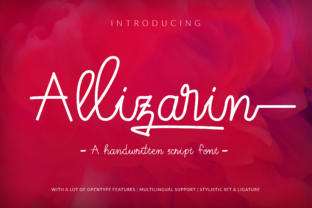
Allizarin is a handwritten typeface designed to evoke authenticity and approachability through its playful, organic letterforms. It features irregular stroke widths, subtle variations in baseline alignment, and natural-looking joins—characteristics that mimic genuine pen-on-paper writing. Unlike script fonts with rigid flourishes or overly formal calligraphic structures, Allizarin balances legibility with expressive personality, making it suitable for contexts where warmth and human touch matter.
Why Designers Consider Allizarin
Designers often explore Allizarin when seeking a font that conveys friendliness without sacrificing visual cohesion. Its appeal lies not in technical precision but in its intentional imperfection: slight inconsistencies in spacing, angled terminals, and soft curves suggest spontaneity and craft. This makes it especially relevant for projects centered on storytelling, personal branding, education, or community-focused initiatives—where tone and relatability influence perception as much as layout or color.
Key Benefits of Using Allizarin
- Distinctive voice: Allizarin stands out among generic sans-serif or overused script fonts, helping designs avoid visual homogeneity.
- Emotional resonance: Its informal rhythm supports messaging around creativity, care, learning, or inclusivity—qualities often reinforced by typographic choice.
- Good readability at moderate sizes: While not intended for dense body text, Allizarin performs well in headings, logos, invitations, and short labels—especially when set with appropriate line height and contrast.
- Compatibility with modern design systems: When paired with neutral sans-serifs (e.g., Inter, Lato, or Open Sans), Allizarin adds contrast without clashing, supporting clear visual hierarchy.
Tradeoffs and Practical Considerations
Allizarin is not optimized for every use case. Its handwritten nature introduces constraints that affect functionality and accessibility. For example, lowercase g, q, and y include looping tails that may reduce clarity at small sizes or on low-resolution screens. Similarly, the font lacks extensive language support beyond basic Latin characters, limiting international deployment. Users should also note that Allizarin does not include stylistic sets, alternate glyphs, or optical sizing variants—features found in more robust type families.
Legibility testing is essential before finalizing layouts. What reads clearly in print at 36pt may become ambiguous in digital interfaces at 20px—particularly for users with visual impairments or reading differences. WCAG guidelines recommend avoiding decorative fonts for critical interface elements like navigation labels or form instructions; Allizarin falls into this category unless carefully tested and supplemented with accessible alternatives.
When Allizarin Is a Strong Fit
Allizarin works best in controlled, intentional applications. It excels in branding for independent creators—such as illustrators, educators, or boutique studios—where personality and differentiation are strategic assets. Wedding stationery, workshop handouts, children’s book covers, and social media graphics benefit from its lighthearted cadence. In editorial design, it can serve as a distinctive headline font for opinion pieces, interviews, or lifestyle features where voice matters more than neutrality.
Its strength lies in singularity: using Allizarin once per project—as a logo lockup, chapter title, or hero banner—creates emphasis without overwhelming. Repetition across multiple interface components dilutes impact and risks visual fatigue.
When to Explore Alternatives
Consider other options if your project demands multilingual support, extended character sets, or strict accessibility compliance. Fonts like Quicksand, Nunito, or Comic Neue offer friendlier proportions and broader language coverage while retaining approachability. For higher contrast between display and body text, pairing a geometric sans-serif with a subtle handwritten accent font (like Architects Daughter) may achieve similar warmth with greater flexibility.
If scalability across devices is non-negotiable, test how Allizarin renders across iOS, Android, and Windows platforms. Some handwritten fonts render inconsistently due to hinting limitations or missing OpenType features—Allizarin is no exception. Previewing in real-world conditions (not just design tools) helps surface rendering quirks early.
Making an Informed Choice
Evaluating Allizarin requires aligning typographic qualities with functional goals. Ask yourself:
- Is the primary goal to convey warmth, individuality, or informality—or to prioritize neutrality, speed of comprehension, or broad usability?
- Where will the font appear? If it’s limited to large-format print or high-resolution banners, Allizarin’s nuances will shine. If it appears in responsive web components or mobile notifications, test thoroughly first.
- What’s the audience context? Younger demographics or creative communities may respond positively to its playfulness; professional services or institutional settings may require more restrained typography.
- Does your team have resources to adapt or supplement the font? For instance, providing alt text for image-based headlines or ensuring fallback fonts maintain hierarchy if Allizarin fails to load.
Remember that typography serves communication—not decoration. Allizarin supports that mission when used deliberately, with awareness of its strengths and boundaries. It is neither universally ideal nor inherently flawed; its value emerges from fit, not novelty.
Before committing, download a trial version (if available) and simulate real usage: set sample text in your intended layout, view it on target devices, and gather feedback from diverse users. This grounded approach yields more reliable insight than aesthetic preference alone. Ultimately, the right font isn’t the most eye-catching—it’s the one that helps your message land clearly, respectfully, and effectively.