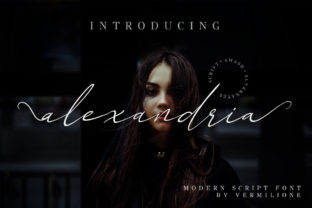
Alexandria Font: A Modern Script with Minimalist Charm for Designers and Creatives
Typography is more than just letters on a page—it’s voice, personality, and intention made visible. Among today’s most beloved script fonts, Alexandria stands out not for flamboyance or extravagance, but for its quiet confidence: a charming, modern script font with a distinctly minimalist feel. Whether you’re crafting a wedding invitation, branding a boutique café, designing a logo for a wellness app, or building a portfolio website, Alexandria offers elegance without excess—and clarity without compromise.
What Is Alexandria—and Why Does It Feel So Fresh?
Alexandria is a contemporary script typeface designed to bridge the warmth of hand-drawn lettering with the precision of digital typography. Unlike traditional calligraphic fonts that rely heavily on dramatic contrast, flourishes, or dense swashes, Alexandria embraces restraint. Its strokes are clean and consistent, its terminals gently tapered, and its rhythm intentionally even—giving it a calm, approachable presence.
Developed with both screen and print in mind, Alexandria features carefully tuned spacing, open counters (the enclosed spaces inside letters like “a” or “e”), and subtle variations in stroke weight that enhance legibility—even at small sizes. This makes it unusually versatile for a script font: equally at home in a headline, a short tagline, or a delicate caption.
The Purpose Behind the Simplicity
At its core, Alexandria was created to solve a common design dilemma: how to convey personality and humanity *without* sacrificing readability or professionalism. Many script fonts fall into one of two traps—they’re either too ornate (hard to read, difficult to scale) or too generic (lacking character, easily forgettable). Alexandria avoids both by prioritizing intentional minimalism.
This isn’t minimalism for minimalism’s sake. Every curve, angle, and spacing decision supports a larger goal: to make expressive typography accessible. That means designers can use Alexandria confidently across contexts—from social media graphics to packaging labels—knowing it will retain its charm while remaining functional.
Where Alexandria Fits in Today’s Creative Landscape
In an era defined by digital speed and visual noise, Alexandria meets a growing cultural preference for authenticity, clarity, and calm. Consider these real-world applications:
- Branding & Identity: A sustainable skincare brand might pair Alexandria with a neutral sans-serif (like Inter or Lato) to signal both care and credibility—soft curves evoke natural ingredients, while clean lines reinforce trustworthiness.
- Digital Interfaces: Though not intended as a body text font, Alexandria shines in UI microcopy—think “Welcome back, Alex” on a dashboard or a playful loading message (“Just one moment…”). Its friendliness humanizes otherwise sterile interfaces.
- Print & Packaging: On a matte-finish candle box or artisanal tea label, Alexandria adds tactile sophistication. Its low contrast and open forms reproduce beautifully in spot-color printing or embossing.
- Educational & Editorial Design: Teachers creating classroom posters or editors designing newsletter headers find Alexandria strikes the right balance between inviting and authoritative—ideal for engaging younger audiences or conveying empathy in health communications.
Common Misconceptions About Script Fonts—And Why Alexandria Breaks the Mold
Many people assume all script fonts are best reserved for formal events or decorative accents. That’s understandable—but outdated. Here’s what often gets misunderstood:
- “Script fonts aren’t legible.” While some highly stylized scripts blur readability, Alexandria was engineered with optical sizing and generous x-height in mind. Tested across devices and viewing distances, it maintains clarity where it matters most.
- “They don’t work in professional settings.” Think again. Law firms, financial advisors, and tech startups increasingly use refined scripts like Alexandria in logos and subheadings—not to appear casual, but to signal thoughtfulness, attention to detail, and human-centered values.
- “Minimalist scripts lack personality.” On the contrary: Alexandria’s personality lies in its quiet confidence. It doesn’t shout; it invites. Its slight irregularities—like the gentle lift in the “t” crossbar or the soft exit stroke of the “y”—add nuance without clutter.
How to Use Alexandria Effectively (Without Overdoing It)
Like any expressive typeface, Alexandria thrives when used with purpose—not just for aesthetic appeal. Here are practical, experience-backed tips:
- Pair it wisely: Combine Alexandria with a neutral, highly legible sans-serif (e.g., Manrope, Figtree, or IBM Plex Sans). Avoid other decorative or high-contrast fonts nearby—they’ll compete rather than complement.
- Respect hierarchy: Use it for primary headlines, quotes, or names—not body copy, captions, or data tables. Let it lead, then step back.
- Optimize for context: In digital use, test line height and letter spacing. Slightly increased tracking (0.5–1.0px) often improves scannability on screens.
- Consider licensing: Alexandria is available through reputable foundries and platforms like Google Fonts (free for web use) and commercial vendors. Always verify usage rights for print-on-demand, apps, or embedded systems.
Why Alexandria Matters Beyond Aesthetics
In a world saturated with algorithmically generated content and templated designs, Alexandria represents something quietly radical: human intentionality. Its design reflects deep understanding—not just of letterforms, but of how people read, feel, and connect with visual language.
For educators, it’s a tool to make learning materials feel warmer and more inclusive. For small business owners, it’s a way to stand out authentically in crowded markets. For developers and product teams, it’s proof that expressive typography can coexist with performance and accessibility goals.
Most importantly, Alexandria reminds us that minimalism isn’t about removing meaning—it’s about distilling it. Every curve is a choice. Every space is intentional. And every time it appears in a thoughtful layout, it reinforces a simple truth: good design serves people first.
Getting Started With Alexandria—No Design Degree Required
You don’t need years of typography training to benefit from Alexandria. Start small:
- Visit Google Fonts and preview the font in different weights and sizes.
- Try replacing the heading on a personal blog post or Canva social graphic with Alexandria—notice how tone shifts instantly.
- Experiment with color: Soft charcoal on off-white feels grounded; muted terracotta on cream adds warmth; deep navy on light gray reads premium and serene.
- Ask yourself: Does this use support my message—or distract from it? If it feels effortless, you’re on the right track.
Remember: Typography isn’t about following rules blindly—it’s about cultivating awareness. Alexandria invites that awareness. It doesn’t dominate a layout; it harmonizes. It doesn’t demand attention; it earns it.
Final Thought: Charm, Clarity, and Quiet Confidence
Alexandria isn’t flashy—but it’s unforgettable. It doesn’t try to be everything, yet fits seamlessly into countless creative needs. In a landscape where trends come and go, Alexandria endures because it answers a timeless question: How do we communicate with both heart and clarity?
Whether you're launching your first freelance project, rebranding a local business, or simply choosing a font for a heartfelt note, Alexandria offers more than style—it offers sincerity, structure, and soul. And in today’s fast-moving, often impersonal digital world, that kind of quiet charm isn’t just appealing. It’s essential.