Tricky Tips: A Handwritten Font with Whimsical Charm for Crafty Projects
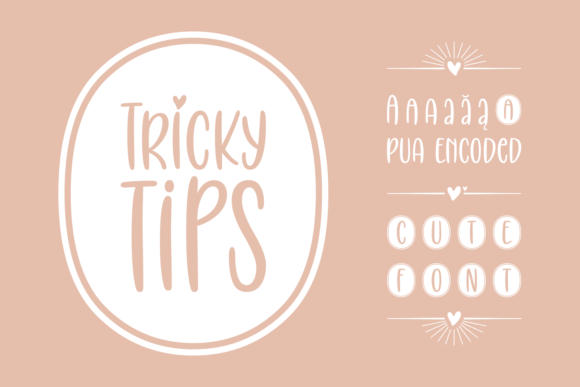
Tricky Tips stands out among handwritten display fonts—not because it’s the most technically refined or the most widely licensed, but because of its distinct personality. It’s a cute and adorable handwritten font with a unique feel: slightly uneven letterforms, gentle irregularities in stroke weight, and a relaxed, almost childlike rhythm that avoids looking overly scripted or digitally polished. That authenticity is intentional—and it’s what makes Tricky Tips work so well in contexts where warmth, playfulness, and handmade sincerity matter more than precision.
What Makes Tricky Tips Different from Other Handwritten Fonts?
Many handwritten fonts fall into one of two broad categories: those designed to mimic formal calligraphy (with consistent contrast, sharp terminals, and elegant flourishes), and those built for casual, everyday use—often optimized for legibility at small sizes or versatility across digital platforms. Tricky Tips belongs firmly to neither group. Instead, it occupies a narrower niche: expressive, craft-oriented typography meant to evoke the joy of paper crafts, scrapbooking, greeting cards, and DIY stationery.
Its lowercase a, g, and y feature open, friendly shapes. Letters like q and p have subtle tail lifts that suggest motion rather than rigidity. There’s no forced uniformity—some letters sit slightly higher or lower on the baseline, and spacing varies just enough to feel human-made. This isn’t a flaw; it’s part of the design language. Unlike fonts engineered for UI labels or branding systems, Tricky Tips doesn’t try to scale seamlessly from mobile buttons to billboards. Its strength lies in controlled, intentional application—where its quirks become assets, not obstacles.
Fitness for Purpose: Where Tricky Tips Shines
Tricky Tips excels when the goal is emotional resonance over functional neutrality. Consider these realistic examples:
- A set of printable party invitations for a baby shower—where soft curves and light-hearted lettering reinforce themes of tenderness and celebration.
- Labels for homemade jam jars sold at a local farmers’ market—where customers respond to visual cues suggesting care, authenticity, and small-batch effort.
- Stickers or die-cut vinyl decals for planners and bullet journals—where users value tactile charm and personal expression over typographic consistency.
In each case, Tricky Tips supports the message without competing with it. It doesn’t demand attention through boldness or novelty—it invites attention through familiarity and warmth. That’s a meaningful distinction when evaluating fonts for real-world use: some fonts are tools for clarity; others, like Tricky Tips, are tools for tone.
Tradeoffs to Keep in Mind
No font serves every need—and Tricky Tips has clear boundaries. Its readability drops noticeably below 18–20 pt in print and below 24 px on screen, especially in longer passages. It lacks extensive language support beyond basic Latin characters, and does not include OpenType features like stylistic alternates, ligatures, or small caps. If your project requires multilingual text, dynamic scaling across responsive layouts, or tight integration with a brand’s broader type system (e.g., pairing with a clean sans-serif for body copy), Tricky Tips may introduce friction rather than cohesion.
Also consider production context. Because it’s a display font—not a system or web font—it’s typically delivered as a desktop-licensed .otf or .ttf file. That means it won’t render reliably in email clients, basic CMS editors, or collaborative design tools without proper embedding permissions. If your workflow depends on shared cloud-based editing (e.g., Figma auto-layouts or Canva templates used by multiple team members), you’ll need to confirm licensing terms and export constraints before committing.
Comparing Approaches: When to Choose Tricky Tips—and When Not To
Choosing a handwritten font often comes down to balancing aesthetic intent with practical constraints. Tricky Tips fits best when the following conditions align:
- The medium is tactile or intentionally low-fi: Think printed zines, hand-assembled gift tags, embroidered patches, or chalkboard-style signage. Its imperfections read as charming, not unprofessional.
- The audience values approachability over authority: Educational materials for young children, wellness brands focused on self-care, or community-led workshops benefit from its gentle voice.
- The usage is limited and curated: One headline per page, a short quote overlay on a photo, or decorative initials in a custom illustration. Less is more here.
Conversely, Tricky Tips is less suitable when:
- You need consistent hierarchy across dozens of pages or screens—its lack of bold or italic variants limits typographic contrast.
- Accessibility is a primary concern: its variable x-height and irregular spacing can challenge readers with dyslexia or low vision, especially in dense layouts.
- Your project relies heavily on automation—for example, generating personalized certificates via a script that pulls names from a spreadsheet. Tricky Tips’ character set and spacing behavior may not accommodate dynamic text flow gracefully.
How Tricky Tips Fits Within Broader Design Decisions
Font choice rarely happens in isolation. It reflects assumptions about audience, channel, brand values, and production capacity. Tricky Tips signals that craftsmanship and emotional nuance are priorities—even if only in small doses. That makes it a thoughtful complement to other design decisions: natural paper stocks, muted color palettes, hand-drawn icons, or photography with soft focus and warm tones.
It also invites reflection on alternatives. For instance, if you love Tricky Tips’ spirit but need better scalability, you might explore hybrid options—fonts that blend handwritten energy with structural discipline (e.g., slightly tightened spacing, more predictable ascenders/descenders). Or, if your project leans into nostalgia but requires broader language support, a carefully selected vintage script with extended character sets may serve better—even if it feels less “cute” at first glance.
Importantly, Tricky Tips doesn’t require full commitment. You can use it sparingly—just for logo accents, section dividers, or social media story highlights—while relying on more robust fonts elsewhere. That kind of layered, intentional mixing is increasingly common among designers who treat typography as a spectrum of voices, not a single solution.
Making an Informed Choice
Evaluating Tricky Tips isn’t about determining whether it’s “the best” handwritten font—but whether it’s the right voice for your specific need, at this moment, with these constraints. Ask yourself:
- Does the project benefit from a sense of handmade imperfection—or would polish and predictability strengthen trust?
- Will the font be seen mostly in static, high-resolution contexts—or will it appear in variable environments where rendering fidelity matters?
- Do you have the time and technical access to test it across outputs (print proofs, screen mockups, accessibility checkers) before finalizing?
If Tricky Tips resonates with your goals, download a trial version and test it against real content—not placeholder text. Try setting a short phrase in three different sizes and backgrounds. Print it. View it on a phone. Read it aloud. Notice where the rhythm works and where it stumbles. That hands-on evaluation tells you more than any description ever could.
Ultimately, Tricky Tips is a reminder that typography isn’t just about communication—it’s about connection. Its whimsical charm isn’t decorative filler; it’s a deliberate cue that says, “This was made with care, for people.” When that message aligns with your intent, Tricky Tips earns its place—not as a default, but as a considered choice.