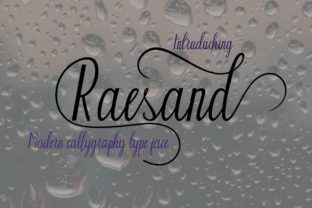
Raesand: Bold Calligraphy with Extravagant Swashes
Imagine a font that doesn’t just say something—but leans in, gestures, and leaves a deliberate impression. That’s Raesand: a modern calligraphy typeface built for impact, not ornamentation alone. It’s not vintage revival or digital mimicry. Raesand is hand-crafted with intention—its strokes are confident, its contrast is purposeful, and its swashes aren’t afterthoughts. They’re structural extensions of rhythm and personality.
What sets Raesand apart isn’t just its visual flair—it’s how it behaves across real-world uses. Unlike many decorative scripts that buckle under small sizes or tight spacing, Raesand maintains legibility at 24pt in a presentation headline *and* holds character at 60pt on a book cover. Its bold weight anchors the design; its swashes offer expressive range—not chaos. You’re not choosing between readability and flair. With Raesand, you get both, calibrated.
Creative Possibilities That Start with Intention
Raesand invites specificity—not just “make it pretty.” Ask yourself: What feeling does this project need to carry? A wedding invitation calls for elegance with warmth—not formality for its own sake. A boutique skincare brand might use Raesand’s longer ascenders to suggest refinement and care. A podcast logo could emphasize one dramatic swash to imply voice, movement, or spontaneity.
Try these grounded starting points:
- Lead with hierarchy: Use Raesand only for primary headlines or logos—not body text. Pair it with a clean, neutral sans-serif (like Inter, Lato, or Manrope) for balance. This keeps attention focused where it matters.
- Isolate one swash: Pick a single letter—often the first initial or final flourish—and let it extend into whitespace. This works especially well on social banners, email headers, or product packaging.
- Rotate thoughtfully: A subtle 3–5° tilt on a Raesand wordmark can suggest energy without sacrificing stability. Avoid over-rotating—clarity trumps cleverness.
Where Raesand Delivers Real Value
Designers and marketers often reach for script fonts when they want “personality”—but end up with inconsistency or weak brand recall. Raesand solves that by offering distinct, repeatable character. Its uppercase letters share strong vertical rhythm; lowercase forms flow without collapsing into illegibility. That means your Instagram story graphic, Shopify banner, and printed business card can all feel like part of the same voice—even if scaled or cropped differently.
Here’s how different users apply it meaningfully:
- Freelancers & small business owners: Use Raesand in your logo lockup and website hero headline—then switch to a supporting sans for service descriptions. This builds memorability without overwhelming visitors.
- Educators & course creators: Apply Raesand to module titles or certificate headers. Its clarity at larger sizes helps learners scan structure quickly—while its warmth supports approachability.
- Bloggers & content creators: Feature Raesand in Pinterest pin titles or YouTube thumbnail text. Its contrast pops against photo backgrounds, and its swashes read clearly even on mobile previews.
- Publishers & indie authors: Consider Raesand for series titles or chapter openers—not full chapter text. Its presence signals intention behind each section, guiding readers emotionally as well as structurally.
Practical Tips for Consistent, Audience-Friendly Results
Raesand rewards thoughtful restraint. Overuse dilutes impact; misalignment confuses hierarchy. Keep these principles in mind:
- Test spacing first: Kerning matters more with swashes. Tighten tracking slightly for headlines (e.g., -20 to -40 units), but avoid compressing so much that swashes visually collide.
- Respect platform limits: Web use? Embed Raesand via variable font files (WOFF2) for performance. For Canva or Figma, install the desktop version first—then export static PNGs for social posts to preserve swash integrity.
- Consider color strategy: Raesand shines in deep tones (navy, charcoal, forest green) or high-contrast duotones (black + terracotta). Avoid light-on-light combos—swashes fade and lose definition.
- Stay legible on screen: On websites or apps, limit Raesand to text above 28px. Below that, switch to a fallback sans with similar x-height and rhythm—like Poppins or Montserrat.
Variations That Extend, Not Distract
Raesand isn’t meant to be endlessly modified—but it responds well to intentional variation. You don’t need alternate glyphs to create distinction. Try these subtle shifts instead:
- Weight layering: Combine Raesand Bold with its Regular weight in the same phrase—say, “Handcrafted” in Bold, “with care” in Regular. The contrast feels human, not mechanical.
- Swash pairing: Use the long swash on the first letter and the short, upward flick on the last. This creates visual bookending—ideal for quotes, taglines, or signature lines.
- Monochrome grounding: Print Raesand in solid black or deep ink—no gradients or textures. Let the letterforms speak for themselves. If adding texture, apply it to the background only.
Remember: Raesand’s strength lies in its confidence—not complexity. Its swashes aren’t filler. They’re punctuation with presence. When you choose where and how to deploy them, you’re making a quiet but powerful design decision—one that tells your audience, “This matters. And so do you.”
Whether you’re refining a brand identity, designing a workshop handout, or launching a new product line, Raesand gives you a tool that’s both distinctive and dependable. It doesn’t ask you to force creativity—it meets you where your goals are practical, your audience is real, and your work deserves to be seen clearly, remembered warmly, and understood immediately.