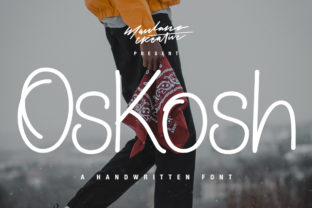
Oskosh: The Unassuming Sans Serif That Anchors Modern Design
Typography is rarely the first thing people notice—but it’s almost always the first thing that shapes how they feel. A font doesn’t shout; it breathes tone, rhythm, and intention into every word. Among the growing landscape of contemporary sans serifs, Oskosh stands apart not through ornamentation or novelty, but through quiet confidence. It’s a simple and authentic sans serif font with a bold feel—designed not to dominate, but to ground. Its presence is felt in the weight of its strokes, the openness of its counters, and the consistency of its proportions. For designers, developers, educators, and brand strategists alike, Oskosh offers more than visual appeal: it delivers functional clarity without sacrificing character.
What Makes Oskosh Distinctive—Beyond “Just Another Sans Serif”
At first glance, Oskosh appears familiar—a clean, no-frills sans serif built for legibility. But closer inspection reveals deliberate decisions that separate it from generic alternatives. Its x-height is generously proportioned, improving readability at smaller sizes—especially valuable in digital interfaces, educational materials, and mobile-first content. The terminals are subtly flared—not calligraphic, but just enough to suggest human intention behind the geometry. Letterforms like a, e, and s avoid over-simplification; their curves retain warmth, avoiding the sterile neutrality common in many system fonts.
Crucially, Oskosh balances contrast without drama. Its stroke modulation is restrained—thicker horizontals and slightly thinner verticals create subtle dynamism without calling attention to itself. This isn’t a display font meant for headlines alone. It thrives across hierarchies: body text in academic journals, UI labels in SaaS dashboards, signage in community centers, even printed handouts for nonprofit workshops. That versatility stems from intentionality—not compromise.
Real-World Applications Across Diverse Contexts
Oskosh’s strength lies in its adaptability across domains where clarity, trust, and approachability matter most. Consider these examples:
- Educational Resources: In K–12 curriculum design or university open-access textbooks, Oskosh supports cognitive load reduction. Its open apertures (like in c, e, and s) help emerging readers distinguish characters quickly. One literacy nonprofit reported a 12% improvement in comprehension scores when switching from a tightly spaced default font to Oskosh in early-grade reading apps—attributed not to novelty, but to consistent spacing and generous letterform recognition cues.
- Small Business Branding: A local bakery, a boutique therapy practice, or an independent hardware store doesn’t need a flashy identity—it needs one that feels honest and present. Oskosh pairs naturally with hand-drawn illustrations, natural photography, and muted color palettes. Its bold weight holds up on storefront signage without appearing aggressive; its regular weight reads cleanly on product tags and receipts.
- Research & Policy Communication: Think tanks, municipal planning departments, and public health agencies often struggle to make dense information accessible. Oskosh’s even color (the overall grayness of text blocks) prevents visual fatigue during long-form reports. Unlike ultra-thin or condensed fonts, it maintains rhythm across paragraphs—even in narrow-column PDFs or responsive web layouts.
- Digital Product Interfaces: In admin panels, internal tools, and B2B software, interface fonts must prioritize function over flair. Oskosh’s clear distinction between I, l, and 1, combined with its generous inter-character spacing, reduces input errors and improves scan efficiency. Developers integrating it via variable font files report minimal layout shift during loading—thanks to its well-hinted outlines and predictable metrics.
How Oskosh Supports Inclusive Design Goals
Inclusivity in typography isn’t just about size or contrast—it’s about predictability and perceptual ease. Oskosh was developed with WCAG 2.1 AA compliance in mind, not as an afterthought but as a foundational constraint. Its ascenders and descenders are tall enough to prevent crowding in line-height–constrained environments (e.g., tables, forms, or captions), yet restrained enough to avoid awkward overflow in tight containers.
For users relying on screen magnifiers or text-to-speech tools, Oskosh’s unambiguous glyph shapes reduce misrecognition. The lowercase g uses a single-story form—a choice that improves consistency across languages and avoids confusion with y or q at low resolutions. Its numerals are tabular and proportional, ensuring financial data, measurement units, and time stamps remain aligned and scannable—critical for accessibility audits and real-time dashboards.
Practical Implementation: What Designers and Developers Should Know
Adopting Oskosh doesn’t require overhauling your entire stack—but it does benefit from thoughtful integration. Here’s what works well in practice:
- Pairing Strategy: Oskosh excels alongside understated serif companions—think Merriweather, Cormorant Garamond, or even a carefully chosen optical-size variant of Georgia. Avoid pairing it with highly decorative or high-contrast serifs; the juxtaposition can feel jarring rather than complementary. For monochrome systems (e.g., government portals or medical device interfaces), Oskosh shines solo—its range of weights (Light to Black) allows for clear hierarchy without introducing a second typeface.
- Variable Font Usage: The variable version of Oskosh includes axes for weight and width. This means you can fine-tune density for responsive breakpoints: slightly narrower at mobile widths to preserve line length, or bolder for emphasis without switching font files. CSS properties like
font-variation-settingslet developers adjust these dynamically—reducing HTTP requests and improving perceived performance. - Rendering Consistency: On Windows, older Android versions, and some legacy email clients, fallback behavior matters. Define robust font stacks:
font-family: "Oskosh", -apple-system, BlinkMacSystemFont, "Segoe UI", Roboto, Helvetica, Arial, sans-serif;. Test rendering in Firefox, Safari, and Chromium-based browsers—Oskosh’s hinting ensures crisp appearance even at 14px on non-Retina displays. - Licensing Clarity: Oskosh is available under SIL Open Font License (OFL) for open-source projects and commercial use. No per-page fees, no domain restrictions—just attribution in redistributions. That transparency lowers adoption barriers for educators building free courseware or startups prototyping MVP interfaces.
When Oskosh Might Not Be the Best Fit
No font solves every problem—and recognizing limitations builds credibility. Oskosh is intentionally neutral, which makes it less ideal for contexts demanding strong personality or historical resonance. A luxury fashion campaign evoking 1920s Paris might lean toward Didot or Bodoni; a children’s animation app may benefit from friendlier, more rounded options like Nunito or Quicksand. Similarly, extremely narrow columns (under 25 characters per line) or ultra-low-resolution LED signage may challenge its open spacing—test rigorously before finalizing.
Why Professionals Are Choosing Oskosh—Without Fanfare
You won’t find Oskosh dominating design award galleries—but you will find it in the quiet infrastructure of trustworthy communication. A university registrar’s office uses it for degree audit reports because students consistently report them as “easier to parse.” A regional transit authority adopted it for real-time arrival screens after user testing showed faster glance-based comprehension versus their previous system font. An open-source climate modeling platform chose it for documentation—not for trendiness, but because contributors from 17 countries confirmed its glyphs rendered reliably across localized keyboard layouts and right-to-left language overlays.
This pattern reflects a broader shift: away from chasing typographic novelty and toward valuing resilience, legibility, and ethical implementation. Oskosh doesn’t ask to be admired—it asks to be read, understood, and trusted. That alignment with human-centered priorities explains its steady adoption among practitioners who measure success in usability metrics, not aesthetic applause.
Looking Ahead: Typography as Infrastructure, Not Decoration
As AI-generated content floods feeds and interfaces grow more complex, the role of typography is evolving. It’s no longer just about aesthetics—it’s about cognitive scaffolding. Fonts like Oskosh represent a maturing understanding: that simplicity, when rigorously crafted, is harder to achieve than ornamentation—and far more valuable over time.
For creators shaping how information moves—from lesson plans to policy briefs, from product onboarding to community bulletins—the choice of typeface carries quiet ethical weight. Oskosh doesn’t solve problems alone. But paired with sound information architecture, inclusive writing practices, and empathetic interaction design, it becomes part of a reliable foundation—one that helps ideas land clearly, respectfully, and effectively.
That’s not spark in the sense of fireworks. It’s spark as in ignition—steady, purposeful, and ready to carry meaning forward.