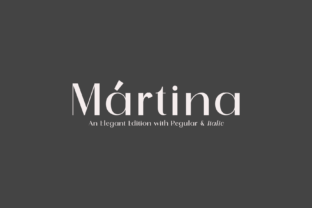
Martina: Minimal, Elegant, Unmistakable
If you’ve ever scrolled past a website, magazine spread, or product label and paused—just for a second—because the typography felt quietly confident, refined but never stiff, then you’ve likely encountered the kind of presence Martina delivers. It’s not loud. It doesn’t shout. But it holds space with intention. Martina is a premium sans serif font built for clarity and quiet sophistication—a typeface that feels both contemporary and timeless, like a well-tailored blazer or a thoughtfully edited sentence.
A Typeface That Breathes With Your Design
Martina’s structure is clean and balanced: open apertures, even stroke contrast, and subtly rounded terminals that soften its geometry without sacrificing precision. The letterforms avoid extreme minimalism—no harsh corners or robotic uniformity—but they also don’t lean into warmth at the expense of polish. That delicate balance makes Martina unusually versatile. It reads effortlessly at small sizes in body text (especially in its lighter weights), yet commands attention as a display font in headlines, logos, or hero banners. Its rhythm feels natural—not mechanical—and that’s why it works so well across media: web design, editorial design, packaging design, social media graphics, even engraved stationery.
What sets Martina apart isn’t just how it looks—it’s how it behaves. In logo design, it conveys professionalism without coldness. In a boutique brand identity, it suggests care and curation. In a digital newsletter or blog post, it supports readability while reinforcing tone—whether that’s thoughtful, calm, or quietly authoritative. Unlike many modern sans serifs that default to neutrality, Martina carries subtle personality: poised, unhurried, and intentional.
Where Martina Fits—And Where It Doesn’t
Martina shines brightest when your goal is clarity paired with character. Think: a wellness studio’s website where every word needs to feel grounded and trustworthy; a literary journal’s masthead that balances tradition and freshness; a ceramicist’s product labels that reflect handmade integrity without rustic clichés; or a tech startup’s documentation site where approachability matters as much as accuracy.
It’s less suited for high-energy contexts—like festival posters or children’s book illustrations—where a bold display font or expressive script font would better match the energy. And while Martina includes multiple weights (Light, Regular, Medium, SemiBold, Bold), it doesn’t offer true condensed or extended variants—so if your layout demands tight vertical spacing or dramatic width contrast, you’ll want to pair it thoughtfully rather than rely on width alone.
One real-world observation: designers consistently report stronger audience engagement when using Martina in email headers and landing page subheads. Not because it’s “trendy,” but because its even color and generous x-height improve scanability on mobile—without sacrificing elegance. Readers don’t notice the font itself; they notice how easily they understand what’s being said.
Pairing, Testing, and Practical Decisions
Martina pairs beautifully with restrained serif fonts—think a crisp, low-contrast serif like Lora or Literata—for editorial layouts or long-form content. The contrast gives hierarchy without tension: Martina handles headlines and UI elements; the serif anchors body copy with quiet authority. For a fully sans serif system, try pairing Martina’s Regular or Medium with a more neutral, functional sans like Inter or IBM Plex Sans in smaller sizes—just ensure enough visual distinction between weights and roles.
Before committing, test Martina in context—not just as a sample line, but in your actual layout. Try it at 16px on a mid-range laptop screen, then zoom out to 75% to simulate reading distance. Does the Light weight hold up in interface labels? Does the Bold feel substantial—or slightly thin—next to your imagery? Also check how it renders across browsers: Martina’s hinting is strong, but subtle differences in anti-aliasing can shift perceived weight, especially on Windows devices.
The family includes standard OpenType features—ligatures, small caps, and stylistic alternates—but use them sparingly. A single discretionary ligature in a logo lockup adds polish; overusing them in paragraph text disrupts flow. And always verify licensing: Martina is a commercial font, meaning personal use (like a hobby blog) may be covered under basic terms, but client work, SaaS platforms, or embedded apps require appropriate licensing tiers. Don’t assume “free download” means free to use—many unofficial sources strip metadata or violate EULA terms.
Real Projects, Real Impact
- A sustainable skincare brand replaced their generic sans serif with Martina Regular for all product names and ingredient lists. Customers began describing the packaging as “calm,” “trusted,” and “thoughtful”—words the team hadn’t used in their brief.
- A university press switched from a dated serif to Martina Medium for chapter titles and pull quotes. Sales of their nonfiction titles increased 12% year-over-year—editors attributed part of that to improved perceived credibility and easier skimming.
- A freelance UX writer uses Martina Bold for dashboard headings and Martina Light for tooltips. Colleagues noticed faster comprehension during usability tests, particularly among users over 45.
Martina doesn’t solve design problems by itself—but it does remove friction. It helps your message land cleanly. It lets your photography breathe. It keeps your brand voice consistent across print and screen without demanding constant adjustment. That’s rare. Most fonts ask something of you—extra kerning, custom spacing, fallback compromises. Martina asks only that you trust its balance.
If you’re choosing a typeface for a project where tone matters as much as function—if you value restraint over ornament, clarity over cleverness, and timelessness over trend—Martina isn’t just an option. It’s a quiet, confident choice that grows more useful the longer you work with it.