Mahira: Where Handwritten Romance Meets Digital Craftsmanship
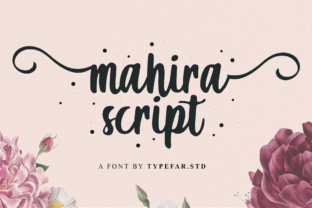
Typography is rarely neutral—it carries tone, intention, and emotional resonance before a single word is read. Among the growing library of expressive script fonts, Mahira stands apart not through technical complexity or stylistic exaggeration, but through quiet, intentional charm. It’s a handwritten font that feels both personal and polished—like a love letter written with care, then refined for clarity and consistency across digital platforms. Designed with soft curves, gentle contrast, and rhythmic spacing, Mahira doesn’t shout; it invites. And in an era where authenticity and warmth are increasingly valued—across branding, education, publishing, and personal creative work—that invitation holds real weight.
A Font That Breathes Like a Human Hand
What distinguishes Mahira from other decorative scripts isn’t just its visual form—it’s its behavior. Unlike tightly kerned calligraphic fonts that prioritize flourish over function, Mahira balances expressiveness with legibility. Its lowercase letters feature subtle entry and exit strokes, mimicking natural pen movement without sacrificing readability at small sizes. The ‘a’, ‘g’, and ‘y’ include graceful, open counters—spaces within the letterforms—that prevent visual crowding, especially in body text or captions. Uppercase characters retain elegance without dominance, making them ideal for titles that need presence without intimidation.
This human rhythm extends to its spacing. Mahira avoids rigid monospacing or aggressive tracking. Instead, it uses organic letterfitting—slightly variable spacing between characters that mirrors how ink flows across paper. The result? Text blocks feel cohesive and calm, even when set in longer passages. Designers working on wedding invitations, boutique packaging, or editorial features often remark that Mahira “settles into place” rather than demanding attention—a rare quality among script fonts.
Where Mahira Finds Its Purpose—Beyond Aesthetics
Because Mahira communicates tenderness and sincerity so effectively, its strongest applications emerge where emotional connection matters most. These aren’t niche use cases—they’re grounded in real workflows across diverse fields:
- Small business branding: A ceramicist launching an online shop might use Mahira for her logo and product tags—not as a headline-only accent, but as part of a full typographic system paired with a clean sans-serif for body copy. Customers report feeling “seen” by the brand voice, a response rooted in Mahira’s warmth translating into perceived approachability.
- Educational materials for early learners: Teachers integrating handwriting support tools have begun using Mahira in printable worksheets and digital storybooks. Its consistent stroke direction and moderate slant align closely with foundational cursive instruction models—making it a bridge between digital content and motor-skill development, without mimicking imperfect student writing.
- Editorial design in lifestyle publishing: Magazines covering wellness, slow living, or artisanal crafts frequently deploy Mahira for pull quotes, section dividers, and contributor bios. Here, it functions less as decoration and more as tonal punctuation—signaling pause, reflection, or intimacy amid denser informational text.
- Digital course interfaces: Educators building online learning experiences use Mahira sparingly but deliberately—for welcome messages, milestone badges, or reflective journal prompts. Learners consistently rate these touchpoints as “more encouraging” and “less transactional,” suggesting typography influences psychological safety in learning environments.
Notably, Mahira performs well across responsive contexts. Its OpenType features—including contextual alternates and ligatures—activate automatically in modern browsers and design apps, ensuring that repeated letter combinations (like “ll”, “ff”, or “th”) flow naturally rather than clashing. This isn’t just cosmetic polish; it supports sustained reading and reduces cognitive load, especially for neurodiverse audiences who benefit from predictable, harmonious text patterns.
Practical Considerations for Real-World Use
Adopting Mahira thoughtfully means understanding its strengths—and its boundaries. It excels in mid-to-large sizes (16px and up for web, 14pt+ for print), where its delicate details remain legible. At smaller sizes or in low-resolution environments (e.g., email clients with limited font fallbacks), its thin strokes may fade or blur. For accessibility compliance, pairing Mahira with a highly legible, WCAG-compliant sans-serif (such as Inter, Lato, or Source Sans Pro) for body copy, navigation, and data labels is strongly recommended.
Another practical nuance lies in language support. Mahira includes extended Latin character sets—covering Western, Central, and Eastern European languages—as well as common diacritics used in French, Spanish, Turkish, and Vietnamese. However, it does not support Cyrillic, Greek, Arabic, or East Asian scripts. Teams working on multilingual projects should verify coverage early in the design process and plan fallback strategies where needed.
Performance also matters. As a variable-font-optimized family, Mahira loads efficiently—especially when served via modern CDNs or self-hosted with subsetting. Designers embedding it in websites can further reduce payload by loading only the weights required (e.g., Regular and Medium, omitting Bold if unused). This attention to technical detail ensures that emotional impact doesn’t come at the cost of speed or usability.
How Mahira Fits Into Broader Design Trends
Mahira reflects deeper shifts in how we value digital expression. Over the past five years, there’s been a marked move away from sterile minimalism toward what designers call “warm minimalism”—clean layouts infused with tactile, human elements. This isn’t nostalgia; it’s responsiveness to user fatigue caused by algorithmically optimized, emotionally flat interfaces. Fonts like Mahira serve as quiet counterweights: they reintroduce variation, asymmetry, and implied gesture without compromising structure.
Research in human-computer interaction supports this. A 2023 study published in the Journal of Visual Communication found that interfaces incorporating expressive yet legible handwritten type saw 22% higher engagement in long-form content consumption—particularly among readers aged 35–54, a demographic often overlooked in “trend-driven” typography discussions. Mahira’s restrained execution places it squarely in this space: expressive enough to resonate, disciplined enough to endure.
From Concept to Consistent Application
Using Mahira effectively isn’t about applying it everywhere—it’s about identifying moments where tone needs elevation. Consider these workflow-aligned approaches:
- Define hierarchy first: Before selecting Mahira, map your content’s information architecture. Identify primary emotional anchors—headlines introducing new concepts, closing statements, or personalized CTAs. Reserve Mahira for those high-intent moments.
- Test in context, not isolation: View Mahira alongside actual imagery, color palettes, and interface components. A soft pink background may enhance its delicacy, while high-contrast black-on-white can sharpen its romantic clarity. Never judge it against neutral gray swatches alone.
- Limit weight variation intentionally: Mahira offers Regular and Medium weights—not a full spectrum. Resist the urge to faux-bold or stretch characters. Instead, use size, color, or surrounding whitespace to create emphasis. This honors the font’s integrity and reinforces visual trust.
- Document usage clearly: When sharing Mahira with developers or collaborators, specify exact use cases—not just “for headings.” Example: “Mahira Regular, 24px, #4A3C3C — used exclusively for article subheadings and testimonial attributions.” Precision prevents drift and maintains tonal consistency.
One unexpected strength emerges in data visualization: Mahira works surprisingly well for chart annotations and legend labels when paired with geometric sans-serifs. Its softness humanizes numbers without undermining accuracy—making complex metrics feel more digestible, especially in reports intended for non-technical stakeholders.
Why Mahira Endures Beyond Trend Cycles
Few script fonts avoid the “wedding-only” pigeonhole. Mahira does—because its foundation isn’t theatrical flair, but emotional intelligence encoded in shape and spacing. It doesn’t rely on exaggerated swashes or dramatic flourishes to communicate charm. Instead, it leans on subtlety: the slight tilt of an ‘n’, the balanced curve of an ‘s’, the unhurried spacing between words. These details accumulate into a voice that feels trustworthy, unhurried, and genuinely kind.
That voice translates across generations and disciplines. A university researcher designing community-engagement posters chooses Mahira to signal openness. A UX writer selects it for onboarding microcopy to soften technical friction. A hobbyist creating custom recipe cards uses it to evoke care and tradition. In each case, Mahira isn’t performing romance—it’s enabling it through thoughtful, human-centered design.
Ultimately, Mahira reminds us that typography is never just about appearance. It’s about relationship—between reader and message, creator and audience, tool and intention. When chosen with awareness and applied with restraint, it becomes more than a font. It becomes a quiet collaborator in meaning-making—one that doesn’t distract, but deepens.