Emerland: Elegant Handwritten Font
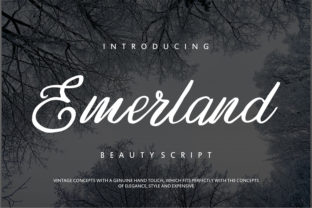
Emerland isn’t just another script font—it’s a quiet confidence in type form. With its graceful, slightly irregular strokes and subtle contrast between thick and thin lines, it carries the warmth of human touch without sacrificing legibility or polish. It feels intentional, not improvised; personal, not precious. That balance makes Emerland especially valuable for creators who need authenticity to land—not as decoration, but as communication.
What Makes Emerland Stand Out
Unlike many handwritten fonts that lean heavily into flourishes or exaggerated bounce, Emerland keeps its rhythm grounded. Its lowercase “a,” “g,” and “y” have soft, open shapes—friendly but never childish. The capitals are restrained, with gentle curves and modest terminals. There’s no forced quirkiness; instead, there’s consistency in variation—each letter feels like part of a real hand’s natural motion, not a looped vector pattern.
This authenticity comes from thoughtful design decisions: slight axis shifts, organic spacing, and a baseline that breathes rather than tightens. As a result, Emerland works at sizes most scripts struggle with—from 14pt body text in an editorial layout to 60pt headlines on social banners—without looking fragile or overwhelming.
Creative Applications That Feel Right
Emerland shines where personality matters more than neutrality. Think of it as your go-to when you want readers to feel invited, not instructed.
- Branding for small studios and makers: A ceramicist’s website uses Emerland for product names and short story blurbs—pairing it with a clean sans-serif (like Inter or Lato) for body copy creates instant warmth and craft credibility.
- Email newsletters and digital zines: Subtle headings in Emerland break up dense text blocks while keeping tone approachable—especially effective for educators sharing teaching resources or freelancers curating client updates.
- Printed materials with tactile appeal: Wedding invitations, workshop handouts, or indie book covers benefit from Emerland’s quiet elegance. When printed on textured paper, its strokes echo the grain—enhancing perceived quality without extra design effort.
Adapting Emerland Across Audiences and Platforms
How you use Emerland depends less on what it *is*, and more on what your audience needs to feel—and how much visual breathing room your format allows.
For marketers and small business owners, Emerland works best when paired with strong hierarchy. Use it only for primary headlines or short calls-to-action (“Join the Studio,” “New This Season”)—never for long paragraphs or navigation menus. On Instagram carousels, keep text overlays minimal: one line in Emerland, centered, over a muted background image. Avoid stacking it with other decorative fonts; let it be the sole voice of character.
Bloggers and educators can use Emerland to signal shifts in tone—like introducing a personal reflection, quoting student work, or highlighting a key takeaway. Try setting a single sentence in Emerland mid-post, then returning to your standard serif or sans. It acts like a visual pause button: gentle, intentional, human.
Designers and publishers will appreciate how Emerland scales across formats. In a PDF workbook, use it for section dividers and exercise titles—but switch to a highly legible font (e.g., Source Serif Pro) for instructions. For responsive web layouts, test line-height carefully: Emerland performs best with at least 1.5x leading to preserve its openness. And always embed it properly—self-host the WOFF2 file or use a reputable font service to ensure consistent rendering across devices.
Keeping It Clear, Consistent, and Audience-Friendly
Authenticity doesn’t mean unpredictability. To keep Emerland effective—not just pretty—apply these practical checks:
- Limit usage to two weights maximum. Emerland includes Regular and Bold. Use Bold sparingly—for emphasis within a headline, not entire banners. Overusing bold undermines its handwritten sincerity.
- Avoid all-caps settings. Its design relies on ascenders and descenders for rhythm. UPPERCASE breaks that flow and reduces readability—especially on mobile.
- Test contrast rigorously. Emerland’s thinner strokes can fade against busy backgrounds or low-contrast color combos. Always verify text passes WCAG AA contrast ratios (4.5:1 minimum) using tools like WebAIM’s Contrast Checker.
- Pair intentionally—not arbitrarily. It pairs naturally with neutral, well-spaced sans-serifs (e.g., Poppins, Manrope) or sturdy serifs (e.g., Merriweather, PT Serif). Avoid other scripts or overly geometric fonts—they compete for attention instead of supporting Emerland’s voice.
Ideas You Can Start Using Today
You don’t need a full rebrand to explore Emerland’s potential. Here are three low-lift, high-impact ways to begin:
- Create a signature email footer. Replace your default “Best regards” line with a short, handwritten-style sign-off in Emerland—“Warmly,” “With care,” or “—[Your Name]”—set at 16pt with generous tracking. It adds distinction without complexity.
- Redesign one recurring slide template. If you present workshops or team updates, apply Emerland to title slides only. Keep body content in your usual font. This small shift signals intentionality—and audiences notice subtlety more than we assume.
- Refresh your Pinterest pin titles. On lifestyle or creative accounts, use Emerland for short, evocative titles (“Slow Mornings,” “Sketch First, Refine Later”) overlaid on lifestyle photos. Its elegance lifts the visual tone without requiring new photography.
None of these require coding, licensing negotiations, or brand overhauls. They’re entry points—ways to test how Emerland resonates with your voice and your audience’s expectations.
At its core, Emerland is a tool for clarity through character. It won’t fix weak messaging or inconsistent strategy—but in the right context, it helps good ideas feel more human, more trusted, and more worth paying attention to. That’s not stylistic flair. It’s functional empathy, built into type.